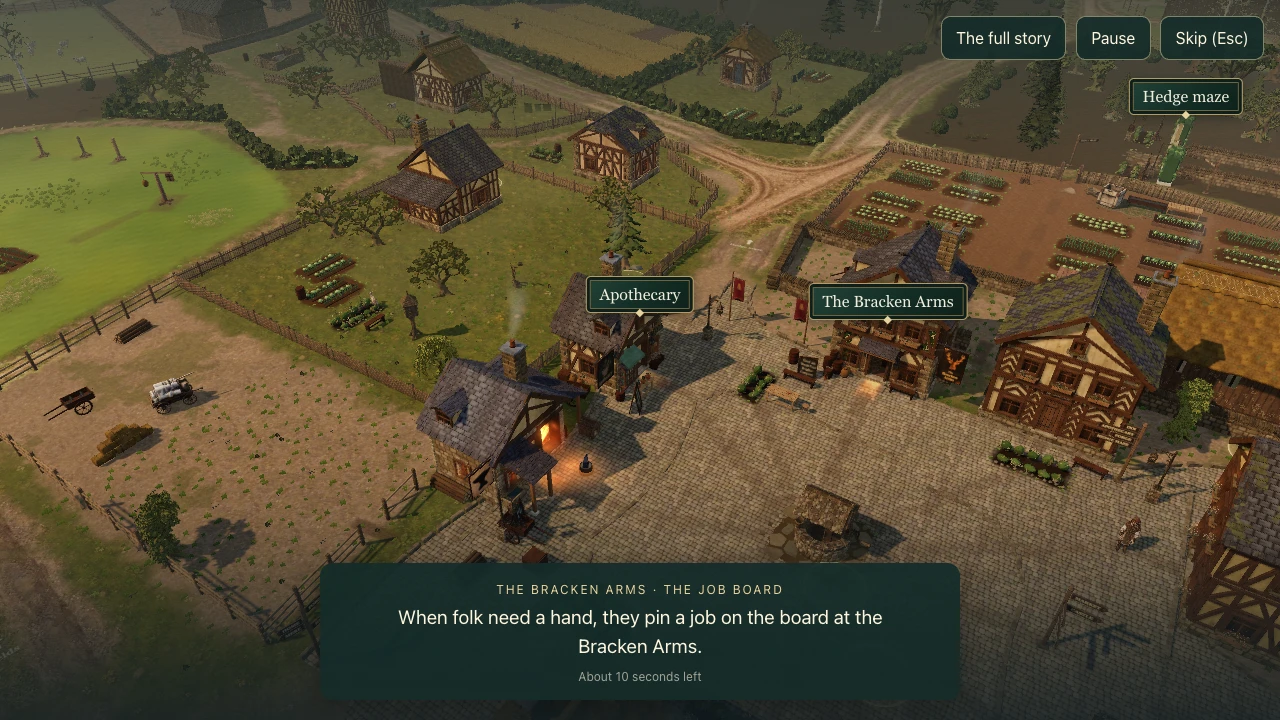
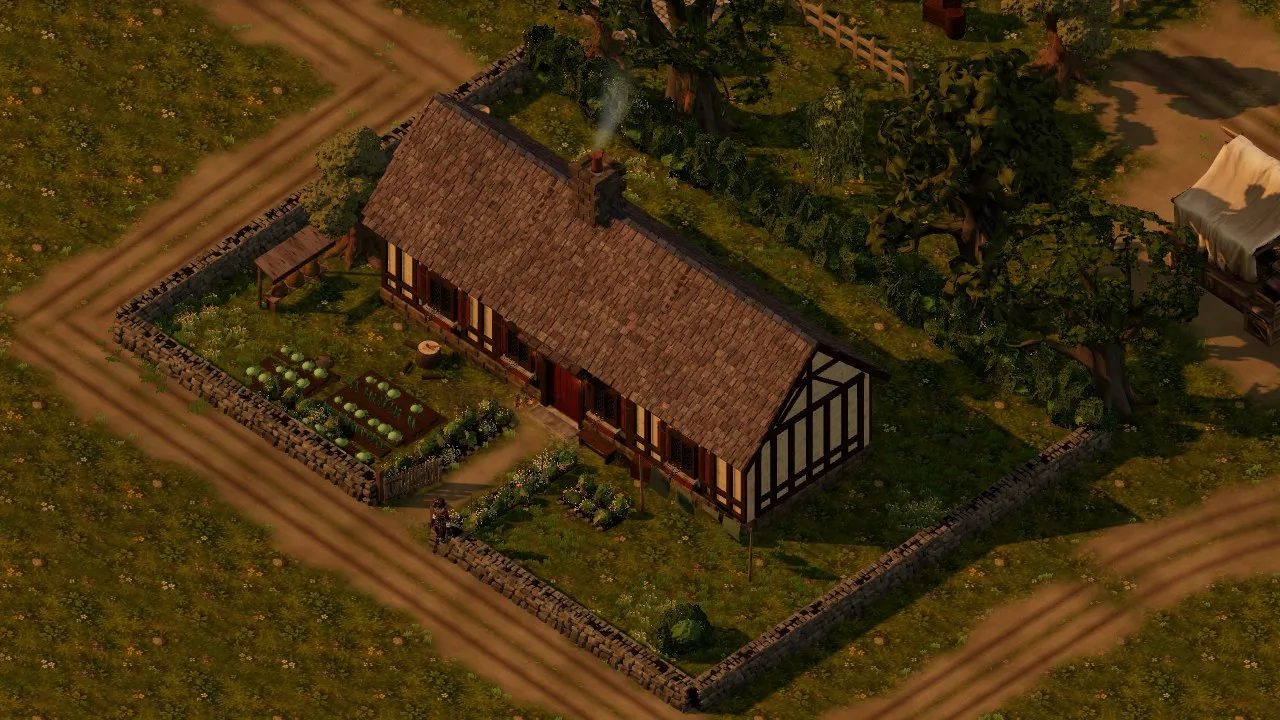
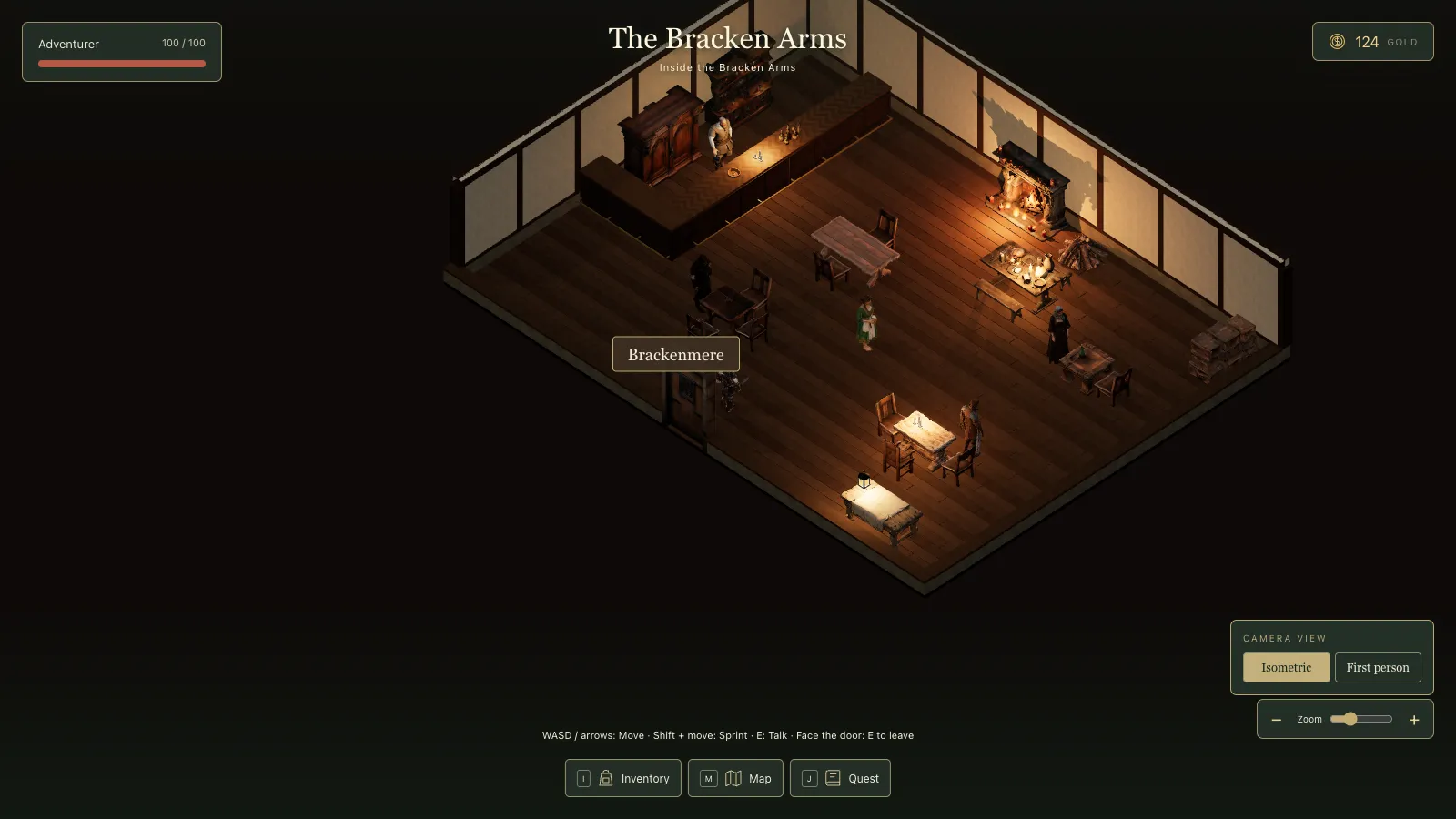
This one is different. Most posts here tell one story. This one is a list.
For a week I mostly played the game. Every time something confused me, annoyed me or simply looked wrong, I wrote it down. On 30 October that was a list running from a to n. On 2 November it ran from a, right through the alphabet, and out the other side to b3. Three play testers, all in one household, sent reports of their own the same weekend. We are so grateful to everyone who plays it and tells us what they find. Alongside that, two bigger pieces of work landed: a whole layer of things to discover in the village's quiet corners, and a pass on how people and monsters move.
The result is well over a hundred changes, most of them small. A toast that disappears before you can read it is a small thing. So is a farewell that mentions a flask you never borrowed. But a game is made of small things, and a new player meets all of them at once.
Performance work ran alongside all of this, and it is left out on purpose. This is only about the game: what you see, hear and do.
 The Bracketts' pig, walked home. It follows the hero's footsteps to the farm yard, and waits if you wander off.
Under the hood The 2 November list alone came to 55 lettered items. They were split into three pieces (the HUD and panels; conversation, town and voice; the world, lighting and generator), each built in its own worktree and reviewed until a review round came back clean, then merged and checked as one.
Quests and finding your way
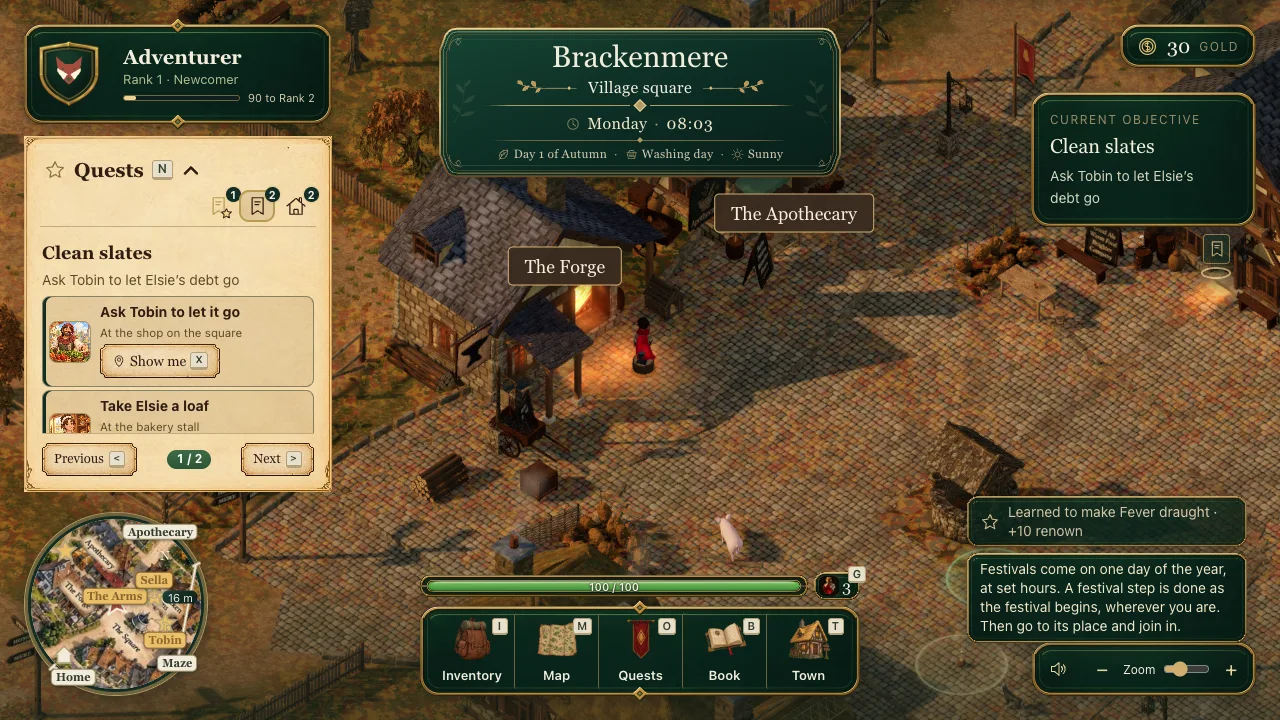
- Three tabs on the Quests panel. Story, Errands and Home, each with a small count. The counts used to look like key caps, and I tried pressing them. They are now small pills, with a title such as "Story: 1 quest".
- Paging works. The panel used to show "1 / 3" whichever page you turned to. Pages now keep a steady order, and the number moves as you go.
- Done steps shrink. A finished step is one thin line: a small picture, the title struck through, and a tick.
- Steps here come first. Steps in the place you are standing show in full. The rest fold into one line per place, such as "+1 in the hedge maze", which opens when you click it.
- Rewards as pictures everywhere. The panel, the quest card and the quest log draw the same reward strip: a gold coin pill and item pictures with counts, with a "?" for anything you have not met yet.
- The panel stays off the map. It used to cover the corner map on smaller windows. It now stops above it and scrolls inside.
- Quest cards fit longer quests. A card lays out six to eight steps without crowding.
- Main quests have a star. The same quest mark is used everywhere, with a gilt star for the main story. People with a side quest to offer now carry a plain quest mark over their head instead of a small dot.
- The done card points at other people who need help. "Folk nearby could use a hand" lists up to two side quests you could pick up next. It never pushes the main story at you.
- The panel stops jumping about. It changes tab only when you accept a quest, never when you hand one in.
- Main quests open on story time. Tilly needs a couple of hours with her father before she can talk about the wolves. Wren only comes to the Arms at dusk. Bram wants a night to think before he sends you down the mine. Until then they tell you why not yet, and when and where to find them.
- A chapter ends with an invitation, not a cut. Finishing the autumn's last quest no longer turns the page by itself. Bram invites you to the Bracken Burning, tonight or tomorrow night, and you walk to the green. The chapter's storybook plays there, among the people you helped.
- No skipping to the moment. Every "rest until the festival" offer is gone. Time passes because you sleep, sit or play. The turn to the next season is offered at the end of the chapter's storybook, and afterwards from the Book or your bed, never on its own.
- Festival steps say which day. "Bracken Burning: the green, in 3 days (autumn 12), from five till eleven", or tomorrow, or today. A tester waited on the green and nothing happened, because it was the wrong evening. If the day is not set yet, the step says what sets it.
- A word about festivals. The first festival step explains them once: one day of the year, at set hours. Arriving early on the day, you are told that folk gather on the green from five and the fire is lit at dusk.
- People who are away say so. A step whose person is out on the moor used to point an arrow at the moor, where nobody was drawn. Now it reads "Out on the moor; back at the bakery from 5", with no arrow.
- Show me leads to the crypts. Guidance into the crypts now points at the chapel, the real way in.
- The chapel says when it is open. "It's locked" became: open on Sundays and feast days, and whenever Reverend Edric or Nan Greave is inside.
- The Adventurer's Book takes the Journal in. The Journal page left the window. The people you have met get a People page with portraits and hearts, and the town's gossip and goings-on get a News page.
- Quests get a story. Every quest has a short paragraph about who is hurting or hoping, and why. I asked for "a little bit more emotional attachment" than "Father can't get to his woods".
- The rank strip sits under every window's title. Your crest, your rank, the bar and what the next rank brings.
- The hand-in card always opens. Handing in a quest could play its fanfare with no card. The talk now closes, the scene plays, then the card.
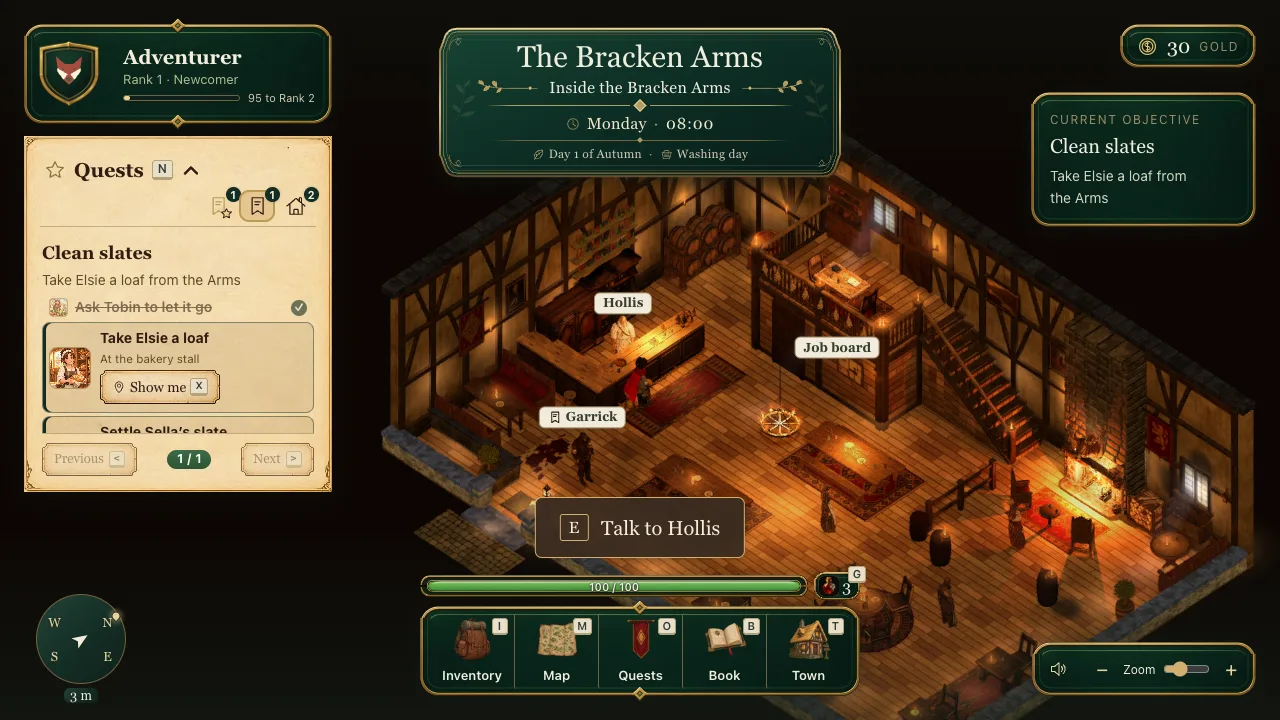 Clean slates under way. The finished step is one thin line; the current one keeps its picture and Show me.
Talking to people
- Answers lead somewhere. Ask Hollis where to get bread and the next replies follow from his answer: "Buy bread", or "Where is the bakery stall?". It used to be only "Can I ask you something else?".
- Buy goes to the thing you asked about. The shop opens on the right shelf, with the bread ringed.
- Plain questions. "Where can I get bread?", not "How do I get a bread?". A shopkeeper no longer tells you they are off duty in the third person, and names keep their capital letters ("Elsie is off duty", not "elsie").
- Goodbyes that make sense. Twenty goodbyes and greetings assumed something you might not know: Ambrose's flask, a sleeping baby, a fish story, a dare. Each is now neutral, or only said when it is true.
- Nan's key. Nan's greeting mentions "the key". You can now ask "What key?", and she tells you to mind your own business, for now.
- Tilly's gift. When Tilly gives you silverleaf, a picture toast says so, and you can thank her.
- Ambrose has a stall. The chandler sells torches, eel oil and an iron lantern from his stall on Market Row, while he is there.
- The quest mark in a reply is a neat green disc with the icon centred, not an icon squashed into a number circle.
- The room and the meal explain themselves. "A night's sleep clears weariness, and you wake rested." "Hunger gone for half a day. Takes an hour." Asking for a room too early tells you when to come back.
- People call you over. When someone walks up to talk, they call out once in their own voice: "A word, if you please?".
- Sit a while. The square's benches and a table at the Arms let you sit for an hour. Someone sits with you and passes on a rumour, and now and then it is someone who needs a hand. The prompt now says plainly that an hour passes.
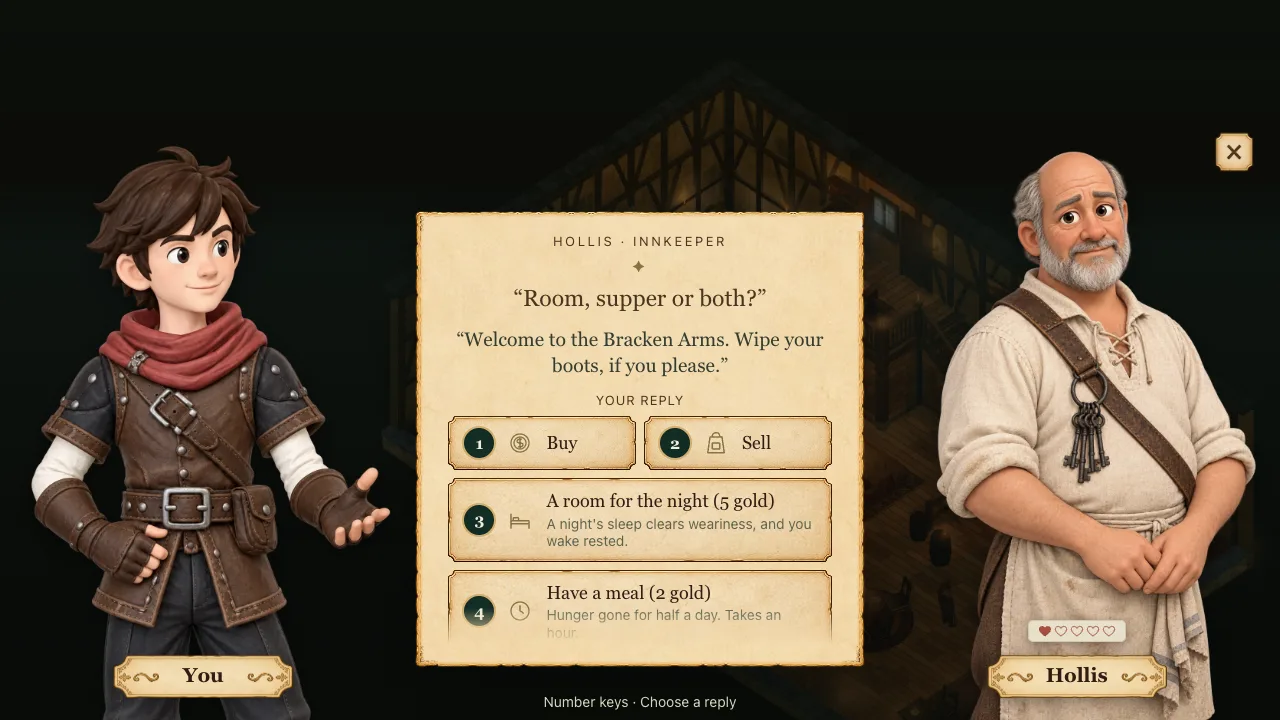 Room, supper or both. Each says what it does for you before you pay.
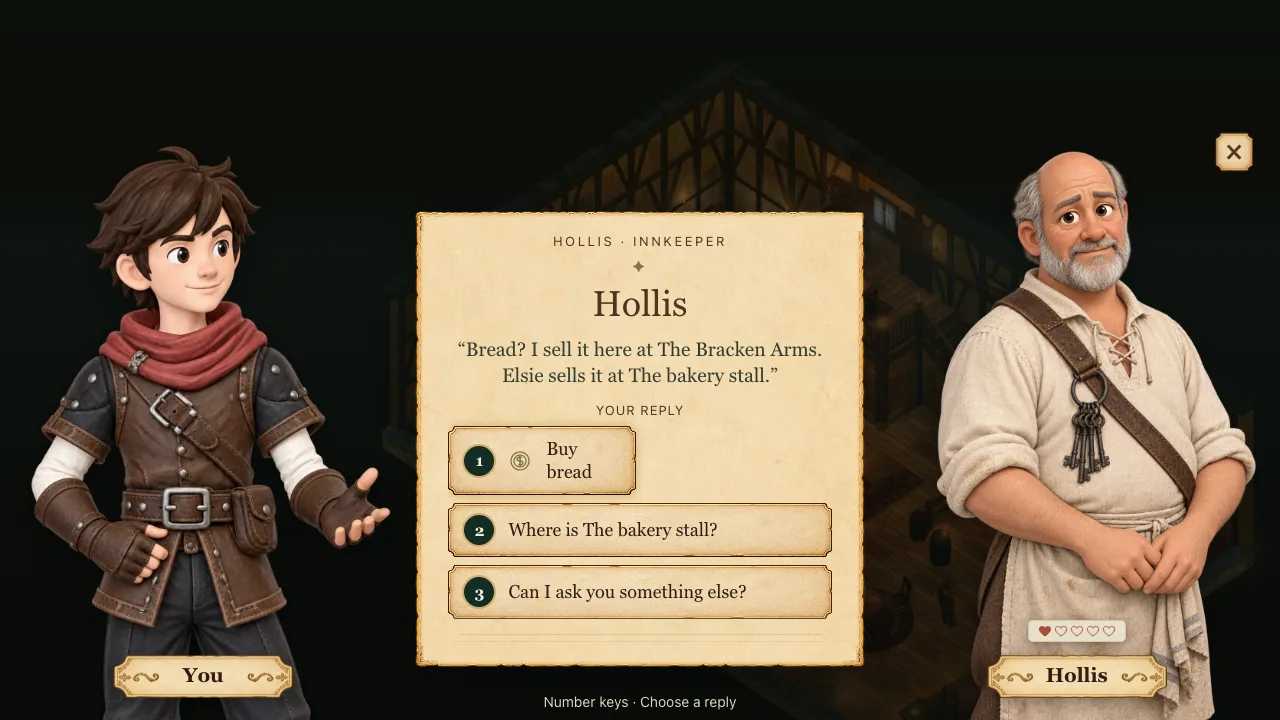 An answer that leads somewhere: buy it here, or find the other seller.
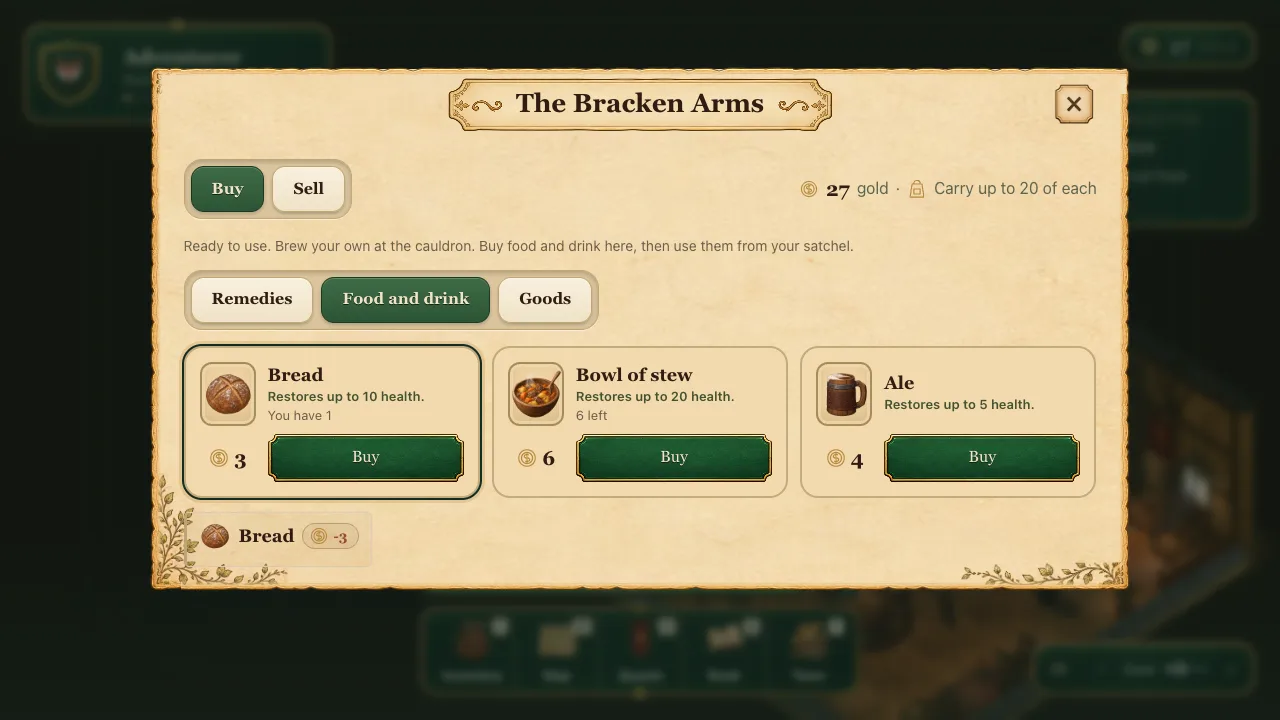 Buy bread opens on the bread. The purchase shows as a picture with its price, not a line of text.
Shops, cards and the satchel
- The button says why not. A purchase you cannot make says why on the button itself: "Need 15 more gold", "Need 1 iron ingot".
- Forge from the card. A piece Bram can improve shows the ingots and gold it needs, and a Forge button when you have them.
- Less to read. Shop cards lost most of their text; costs are pictures.
- A hungry buyer is asked. Buying food at the Arms while hungry, Hollis asks whether you want a hot meal now instead. The bread is for the road.
- Potion cards became bottles. Each recipe is a bottle tile with a slot for every ingredient, its effect, how many you hold and how long it lasts. Tap it open for the details.
- The brew card. When a find completes a recipe, the game pauses and the potion turns into view: you can brew this now, at Mother Agnes's cauldron.
- Forge upgrade cards lay out their materials as tiles, with "have / need" on each and the gold on its own line.
- The lesson card names what it wants. The item, "You have 0 of 1", and where it can be found.
- Trophy spots explain themselves. An empty wall spot says it is a wall spot and which of your trophies would hang there.
- The satchel fills the panel, six across on a wide window. The ruby's note no longer mentions a "specialist" nobody has met.
- Glowcap has a use. Crush one for half a minute of light.
- Chests hold more than coins. Ingredients from the place, sometimes a potion, and now and then nothing but dust and bones, which Bram says aloud.
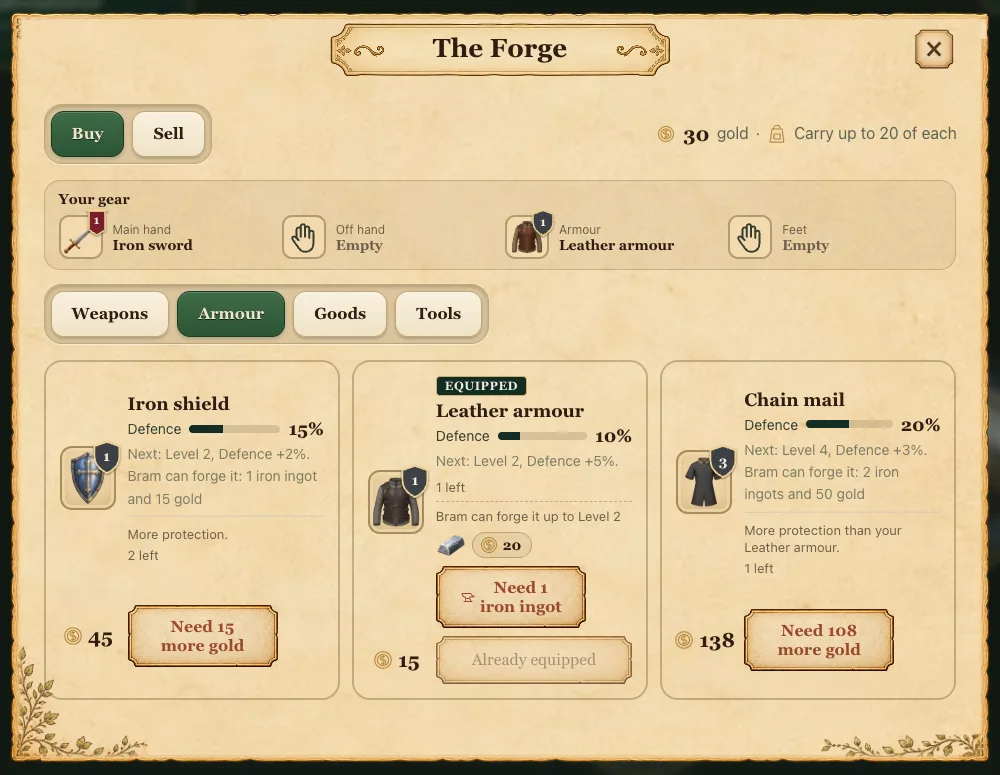 Every button says what is missing. The worn leather armour shows its forge cost in pictures.
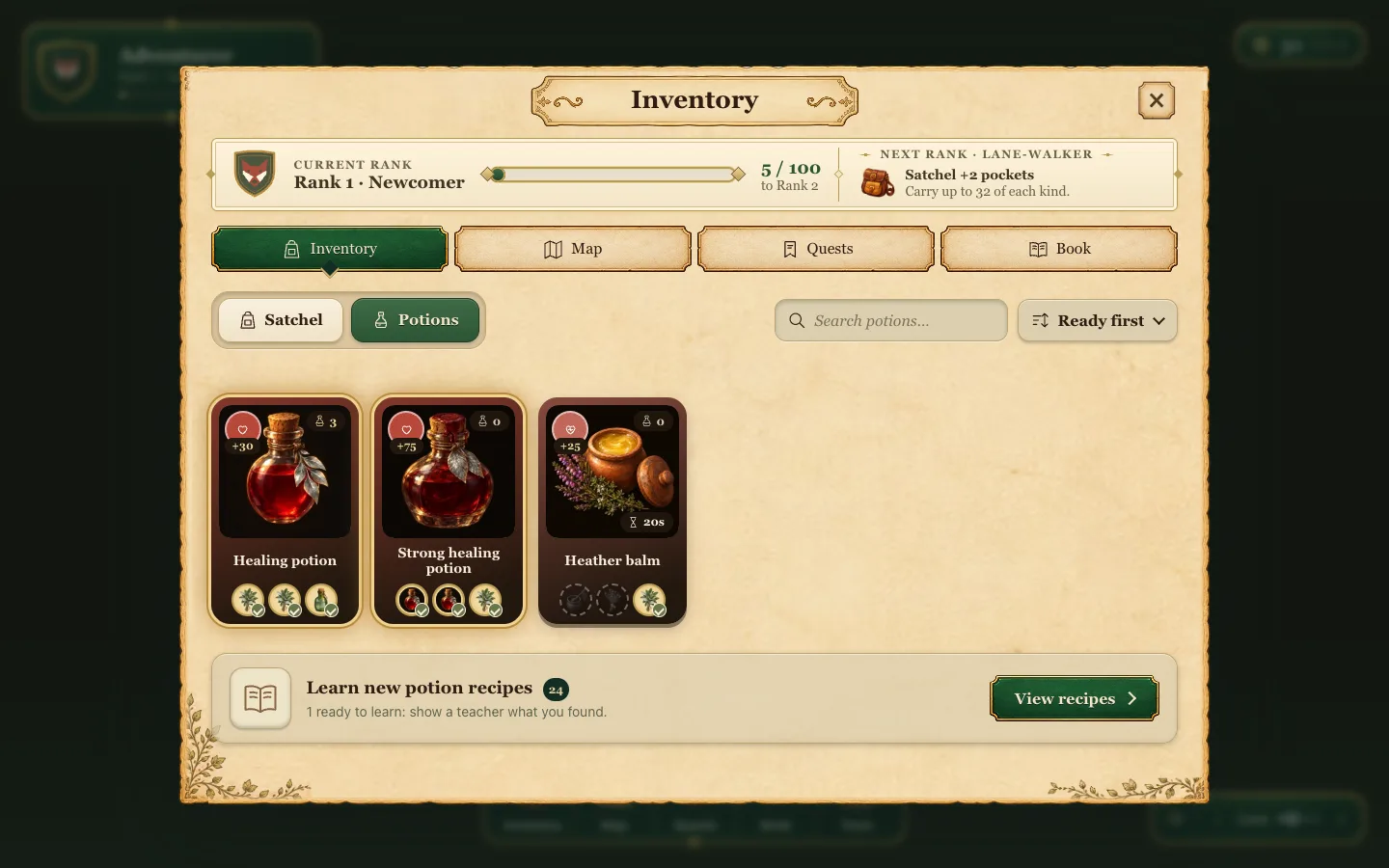 Potion cards as bottles. The slots under each bottle fill as you gather.
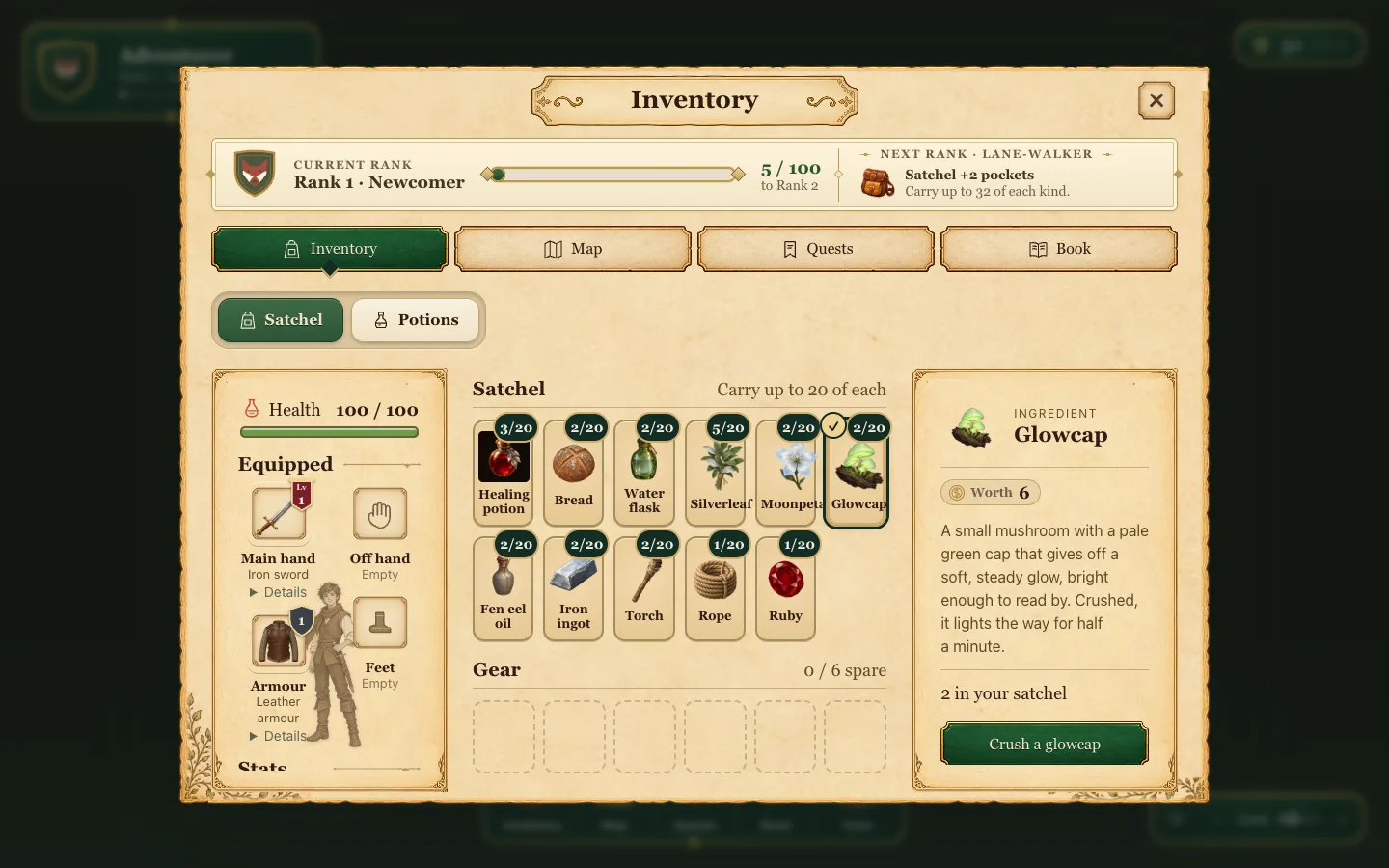 Glowcap, crushed for light. The satchel grid now uses the panel's width.
The HUD and the map
- Toasts last as long as their words. A long line stays up long enough to read; a short one goes quickly.
- Corner map labels stay on one line and use short names ("The Arms"). A quest spot is named for its step, never "The spot".
- The chosen crest stands out with a light fill, a forest border and a gold ring.
- The hunger chip pulses when you are famished, and opens the Home tab's Hungry page when you click it.
- The direction pointer is a stubby arrow, not a long thin needle.
- The EQUIPPED ribbon no longer sits over an item's name.
- One set of panel parts. Tabs, sub-tabs, search, sort, banners and back buttons are the same pieces on every page.
- The map got its edges. Unexplored ground sits under fog with a feathered edge, walls and seen ground draw as joined, smoothed shapes, and there is a compass and a legend. The big map fills the page under the rank strip.
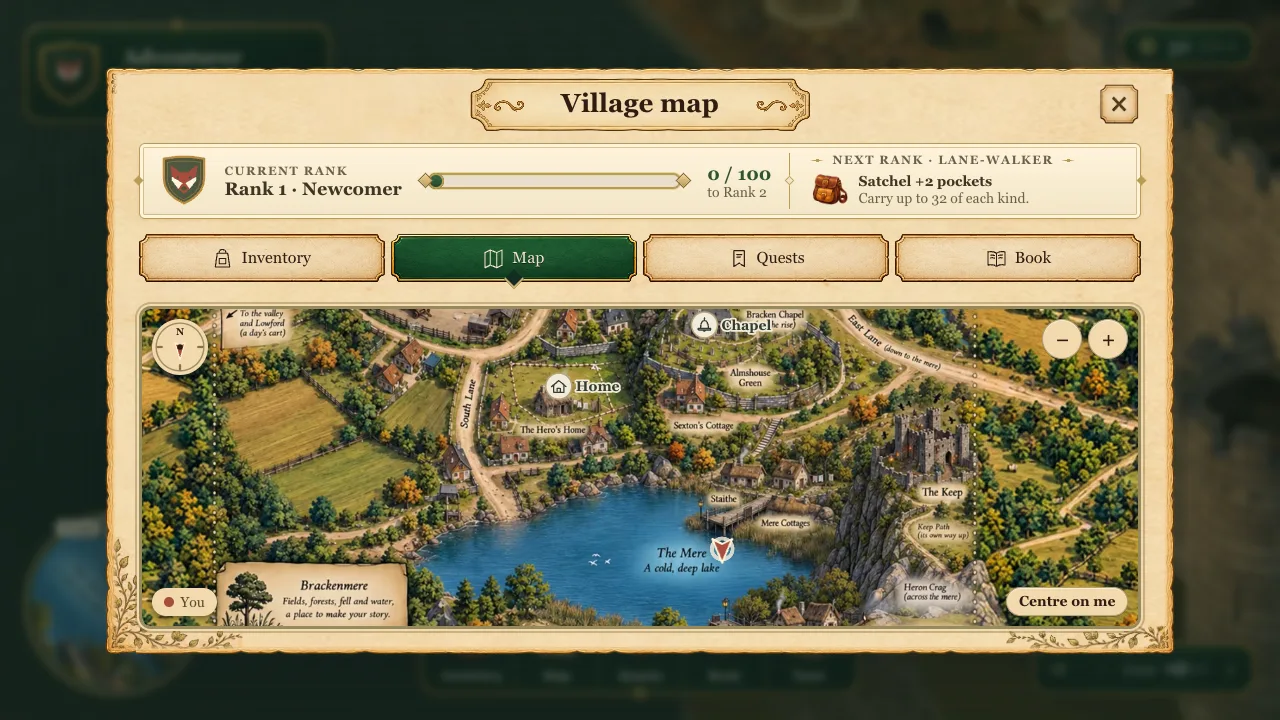 The village map fills its page, with the rank strip above and the panel tabs under it.
First person and the camera
- No more first-person card. The "Continue in first person" card is gone. Without the mouse, one quiet line sits under the crosshair: click or press a key to look around. Any key but Esc takes the mouse back, after a door as well as on a fresh load.
- Talking does not cost you the mouse. Closing a conversation by choosing a reply takes the mouse straight back.
- No sudden spins. A single wild mouse jump, which could spin the view in the maze, is ignored.
- Your hand holds your sword. The first-person hand is the same fist whatever sword you carry, with the equipped blade in its grip.
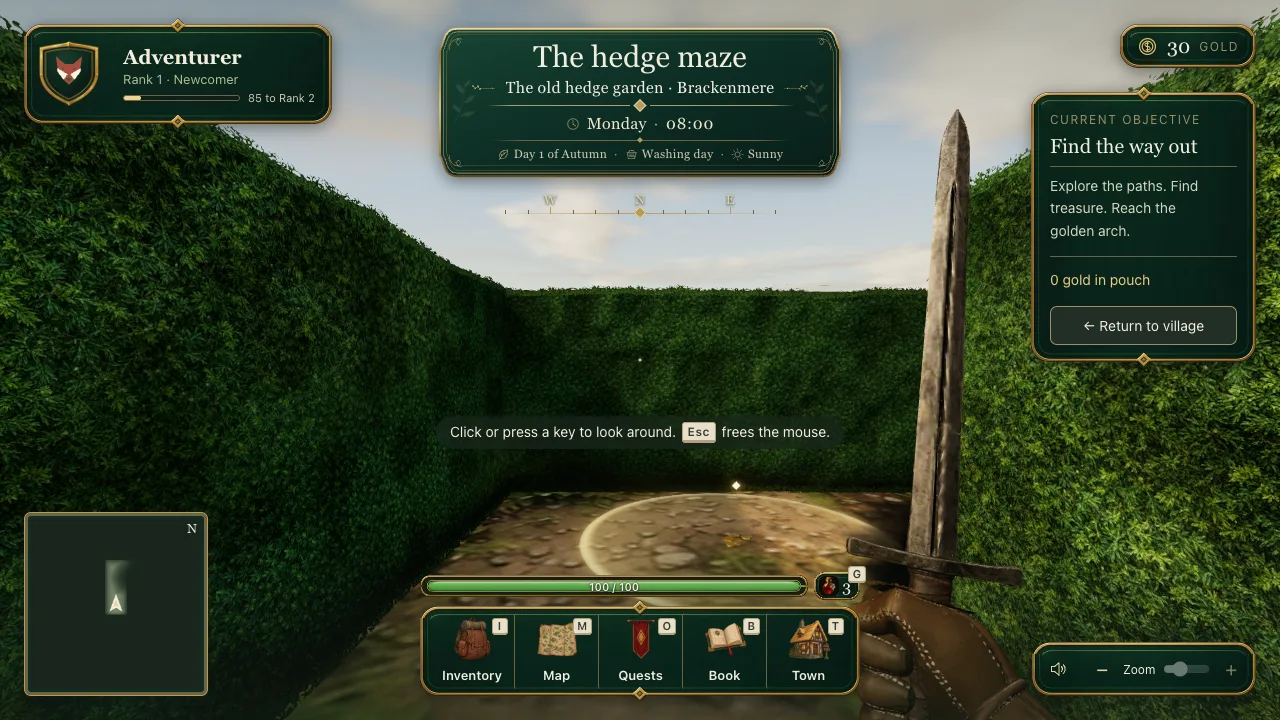 One line under the crosshair instead of a card in the way.
The village and its secrets
The biggest single piece of the week. The idea is that the world shows you things before anyone names them, and that every quiet corner is worth a visit on your first day.
- Twenty-seven quiet places each have something to see and something to find, available on a new save, before any quest.
- The Book's Places page has blanks. Each quiet place is a blank card with a one-line hint until you have heard of it or been there.
- Help comes as a ladder. Stuck on a clue, you get a nudge after a while, a firmer one later, and the answer last. Asking skips ahead.
- Quests can start from what you find. A name over a door, a bench, a candle at a grille. A main-story clue you saw early is remembered, and the person who gives that quest knows you saw it.
- Carved marks. A heron, a barrel and cross, and five notches turn up in stone and wood around the village and beyond.
- The still mill wheel. The old mill's wheel does not turn. Free the millstone and it turns again, where you can see it from the square.
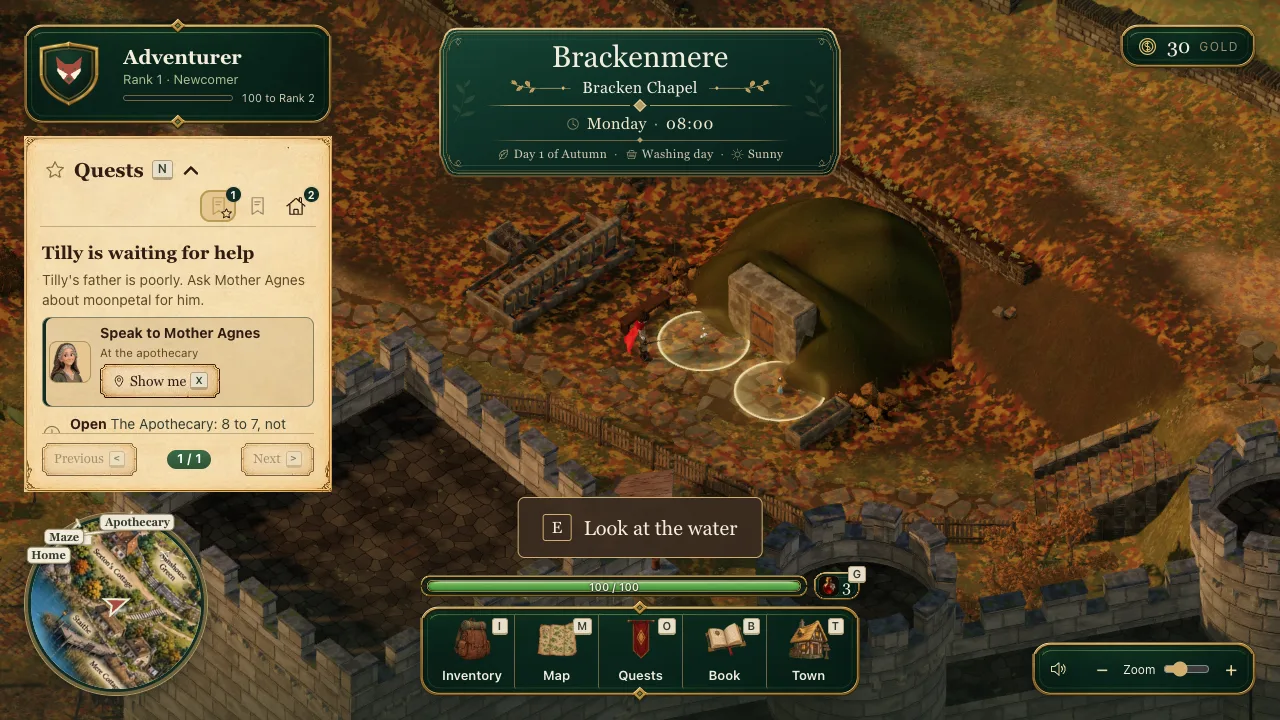
- The ice house dare. The children dare you. The key hangs on a hook in the Arms, and Hollis pretends not to see.
- The tithe barn doors open with a puzzle of stones in two boxes on the beam.
- Brannoc's spring has nine channel slabs. Open the right three and the water runs.
- The wheel pit grate opens with the Rat King's keyring onto a short tunnel that ends under the well.
- A cracked wall in the old bailey breaks through to a Vere cellar.
- The empty far cottage across the mere: boarded up, a light in its window some nights, and sometimes a goblin bolting out of the back with a turnip. Its cellar leads to a goblin tunnel, and clearing it means fewer raids.
- Your home's cellar, and under one flagstone, Silas Crewe's sea chest and the fifth stone.
- Under Brackenmere, a Book page that draws the ways beneath the village as you find them, dotted where you have only heard they join.
- The crag lamp on Heron Crag lights when you hold a cold stone and brightens with each stone. The cold stone frosts near the places it belongs.
- Sounds that point somewhere. Wolves beyond North Lane at dusk once the remedy is done; three notes of a bell off the staithe at dawn.
- Forage moved to the quiet places: cress at the spring, comb at the skeps, honey on the moor, reeds at the washing stones.
- Little happenings: a light in the mill loft, something small at the bakery bins at night, with crumbs and footprints left by day.
- A climb up the crag with Tobin's grapnel to a lookout that names the places you can see from it.
- The garden walk round the outside of the garden wall opens after Fen's promise, and ends at a bricked-up door.
- A brambled footbridge to the north woods, cleared with the ember pot.
- The King Mound's door appears on the moor's skyline later in the story.
- Clues in the worlds next door: a tally post in the Charwood, a cracked rock in the mine, a banging gate at Frostpeak, heron prints in Whisperfen, and a sundial in the hedge maze.
- People where their stories say they go: Lob at the tithe barn at sunset, Hollis in his kitchen garden at dawn, and Old Nat on the almshouse bench, where you can sit and hear one of his tales each day.
- The name over the door. "S. CREWE" is cut into the oak over your home's door, and the Crewe headstone and its neighbours carry their names.
- Locked ways tell the truth. Exits that refuse you now name what is in the way, rather than "ask in the village".
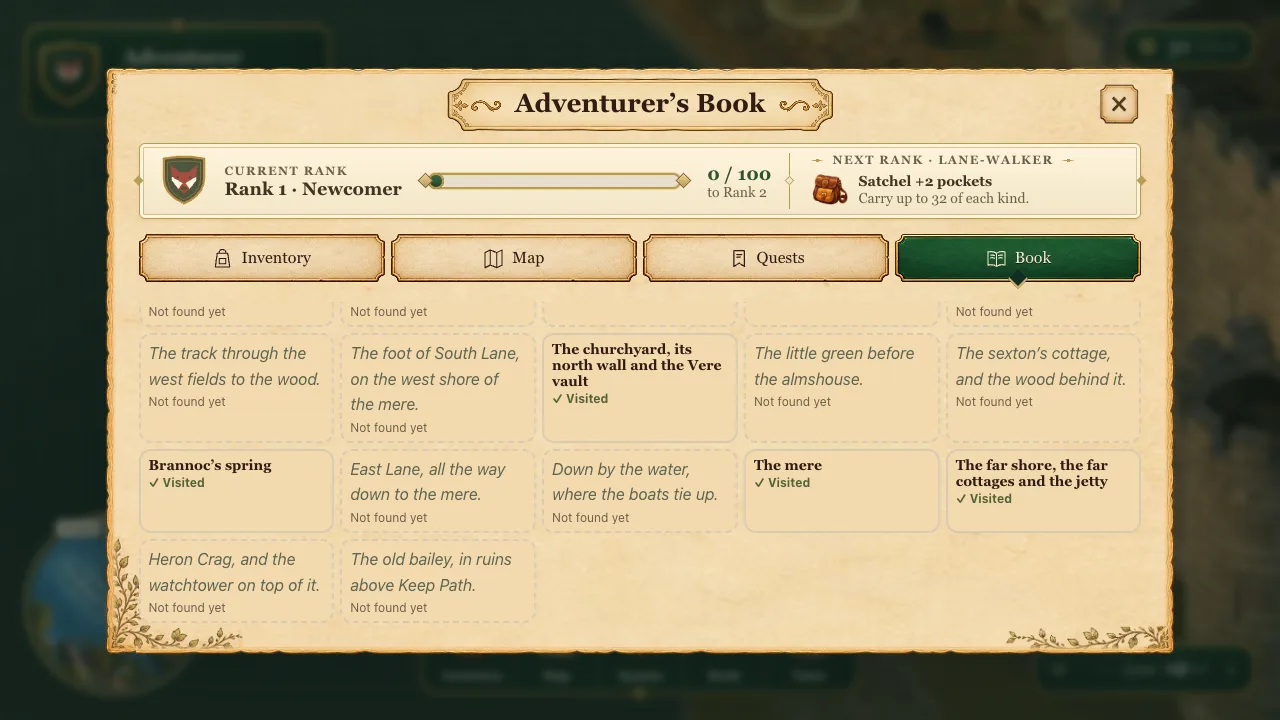 Places in the Book: a hint for every quiet corner, and a tick once you have been.
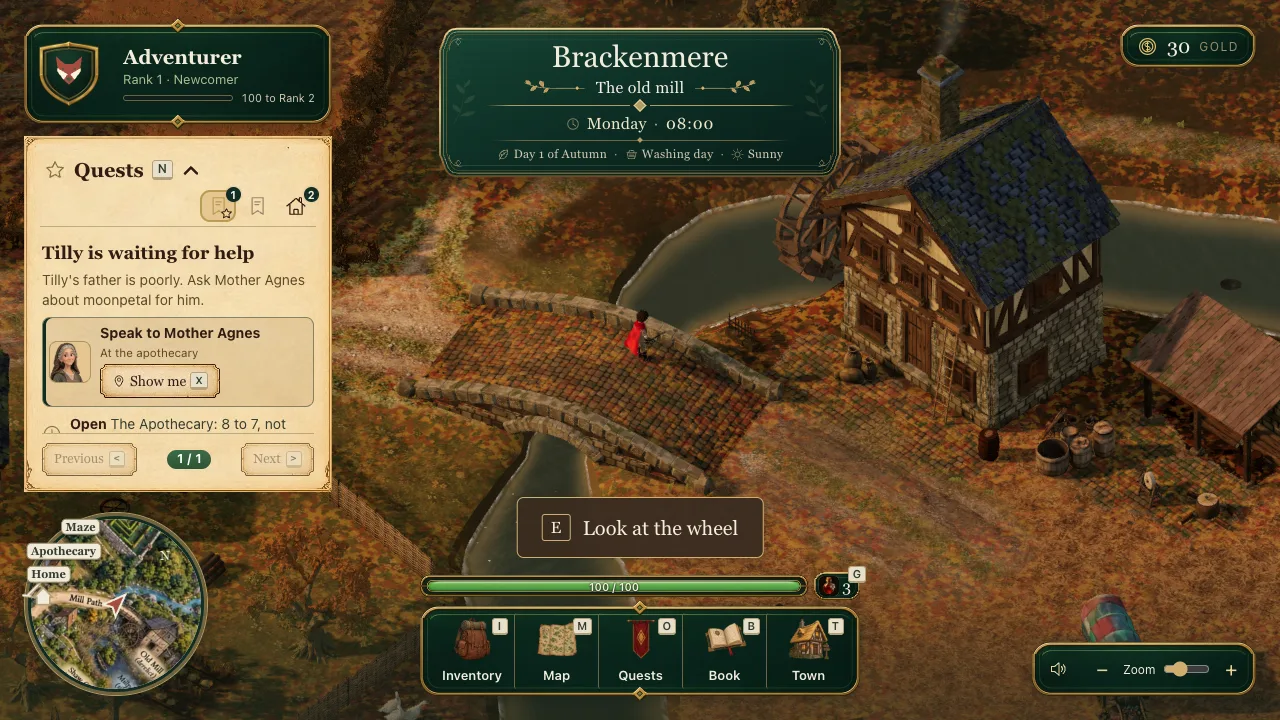 The old mill. Its wheel stands still until you free the millstone.
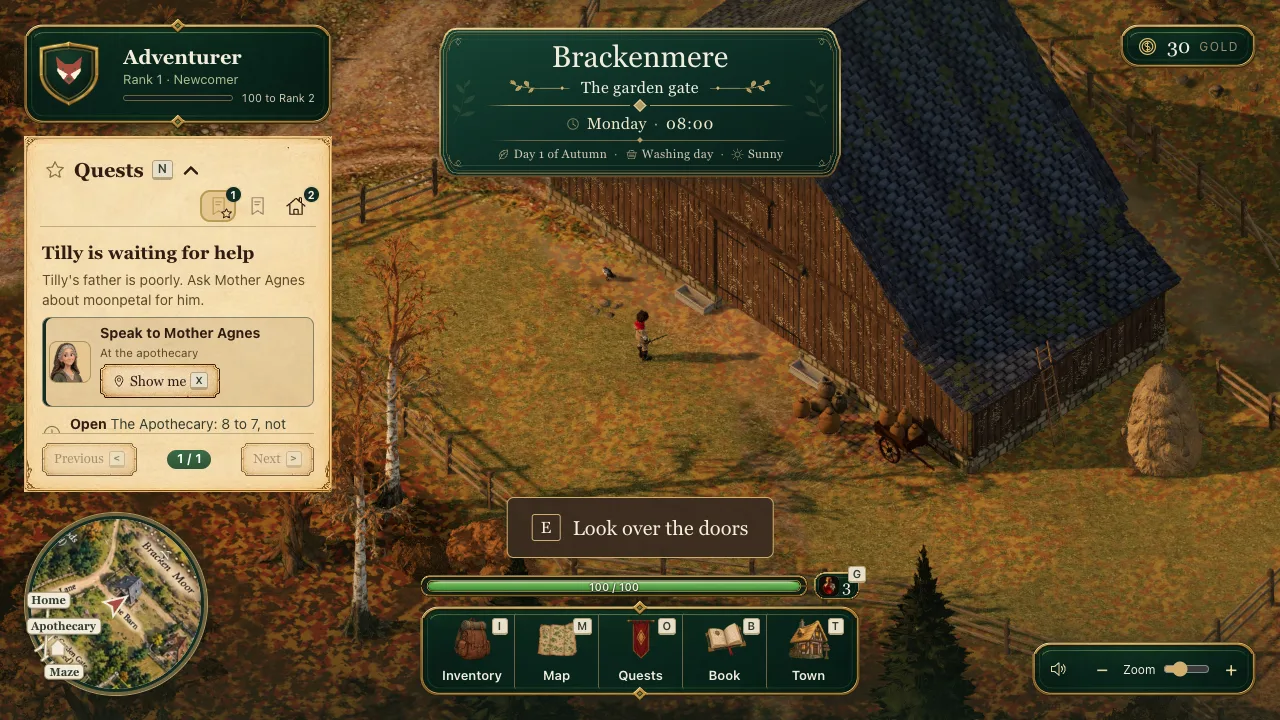 The tithe barn's doors, with their two stone boxes on the beam.
 Brannoc's spring and its channel slabs.
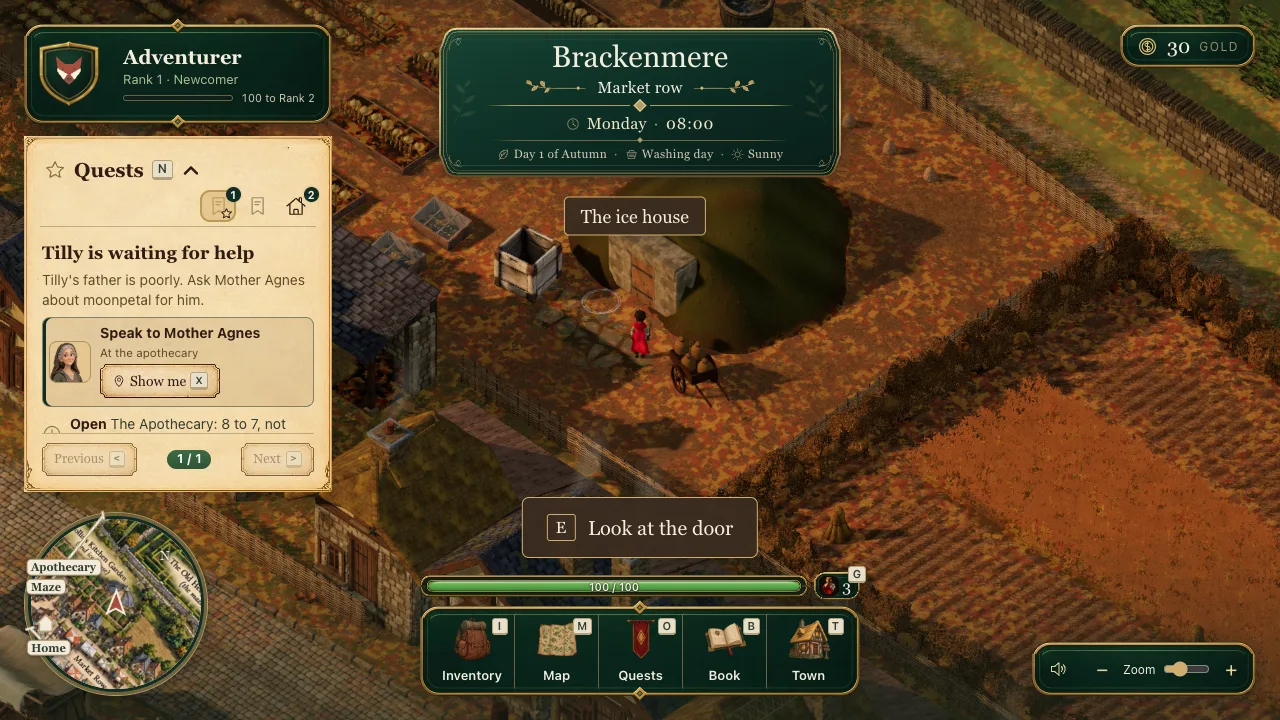 The ice house, the children's dare.
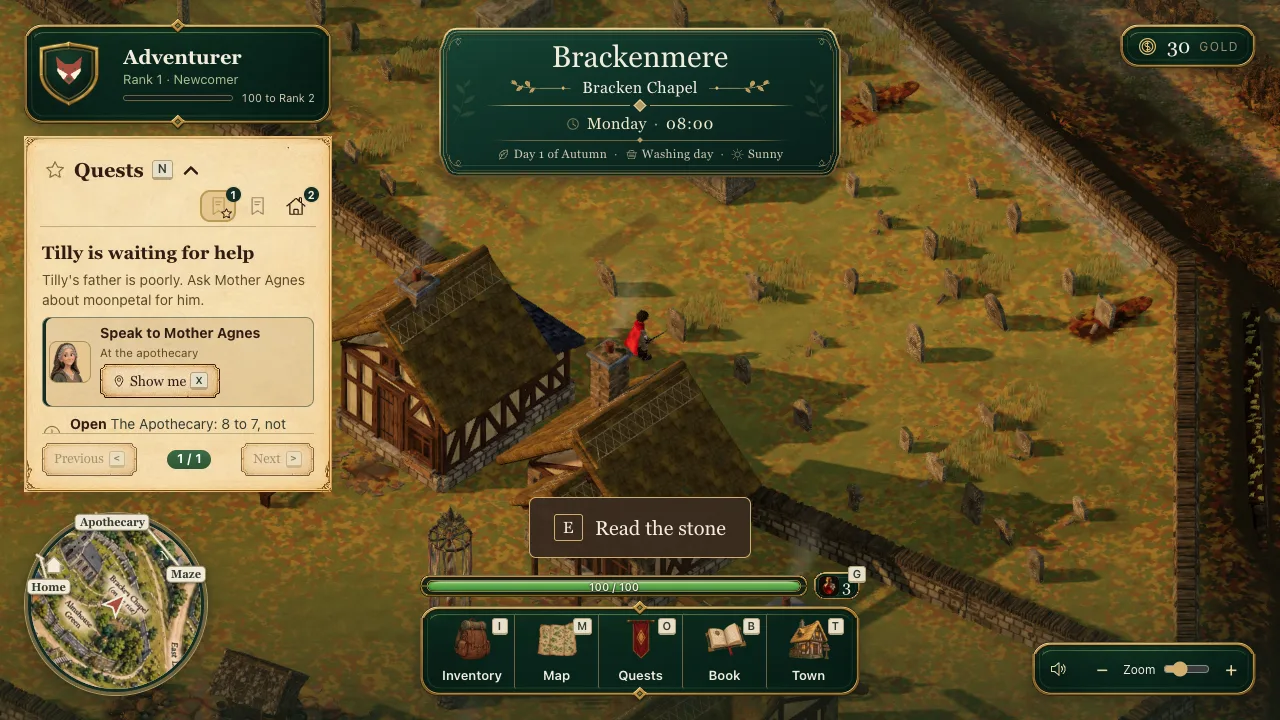 The Crewe stone, with the name cut where you can read it.
People and animals that move better
- Townsfolk turn on their feet. They step round instead of sliding, start and stop in step, and look at you with their heads, up and down as well as side to side.
- Little differences. Each person has their own idles; hands land on counters; feet sit on uneven ground.
- Monsters feel alive. They breathe while standing, turn with weight, circle you with sidesteps that their feet can actually make, and blend from one move into the next.
- Carried loads sit properly. Lamp's sack rides on his shoulder and leans with him, and loads stay in hand for a moment after stopping, so they no longer flicker.
- No more shuffling in doorways. Someone who has stepped aside three times without getting anywhere settles where they are.
- No more black hats. The rain hoods on townsfolk are gone; the shawls stay.
- Goats and geese move. They graze, wander and waddle, and startle when you swing near them.
- Walk the pig home. The Bracketts' loose pig and the lost lamb on North Lane follow you home. Hilde thanks you when the pig is back in the yard.
- Walk Bun home. Bun follows you to the well in the square, and a card thanks you with a honey bun.
- Folk notice when you swing at their animals. The first time, Bram has a word, with a short reaction for each kind of animal.
The hero
- A cape that shows your rank. A newcomer wears red, turning blue at rank 2, then green, purple, crimson and cream as you rise, with the scarf changing too.
- The cape flows. It sways and trails instead of snapping back at every step.
- A cleaner face. The hero's face is smoothed, gloves and trousers take their colour under armour, and the sword hand closes round its hilt.
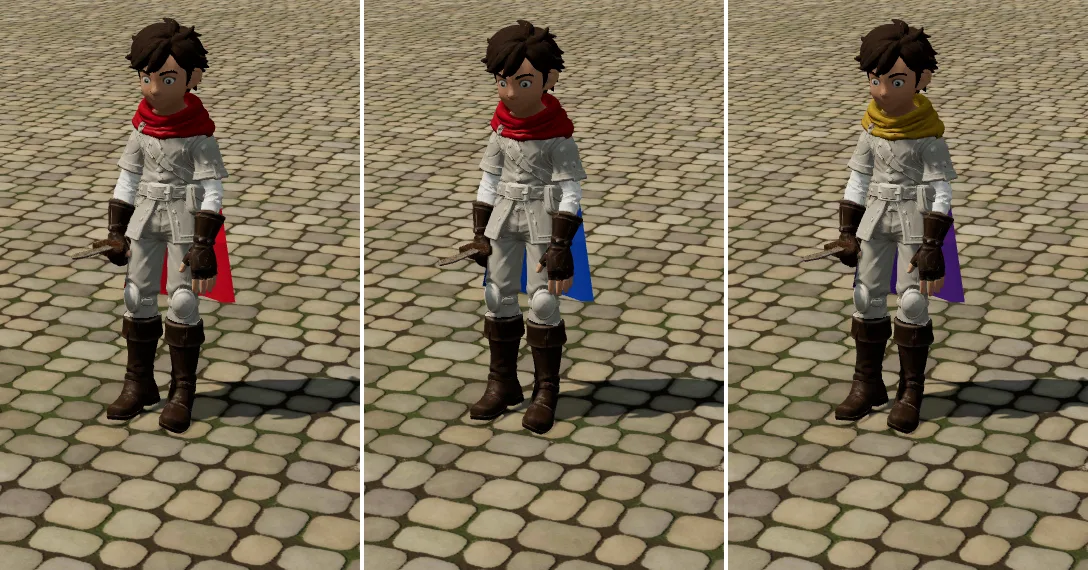 Ranks 1, 2 and 10 in the look lab: the newcomer's red cape, blue at rank 2, then a gold scarf and a purple cape.
Fights, the crypts and the wider world
- Defeat tells you what happened. In a run you are back at the entrance, and told what happened to the gold in your pouch. Knocked down in a raid, you hear that you are back on your feet with all your things. I thought defeat dropped your gear for you to collect. It does not: you keep your items, and the words now say so.
- Dropped herbs wither, and the first time it happens you are told.
- The crypt stair asks before you leave. The stair back to the village mid-quest used to walk you out. Now it says the crypts go on, and asks.
- Candle stands carry their numbers. Each stand has its numeral cut in stone, and the minimap shows the numbers, turning yellow once lit.
- Lighter crypts, keep and mine. Lit rooms read clearly now; unexplored dark stays black.
- Nights are dark dusk, not black. The moon and the night sky are a touch brighter, and rooms indoors are no longer pitch black after dark.
- Hedge mazes get corners and courts. Generated mazes put ornaments in some corners and now and then open a fountain court.
- Levers near their gates. A lever no longer hides at the far end of the maze from the gate it opens.
- Maze minimaps show dead ends, chests and things to use, without decoration.
- New crypt skulls in the niches.
- The Fen's way in explains itself. With gold in your pouch, the signpost tells you this is the way you came in, and only the ferry gets your pouch home.
- Chests behave. The castle alcove chest faces the room, the risen chest in the Fen stays solid, and the tinkering goblin carries only his hammer.
- Banks you cannot jump in the Charwood and the Fen are now clearly too high to try.
- Village fixes. The old hammer lies flat on the Fenns' table, the far jetty runs into open water clear of the crag, and troughs and ploughs no longer sit through fences.
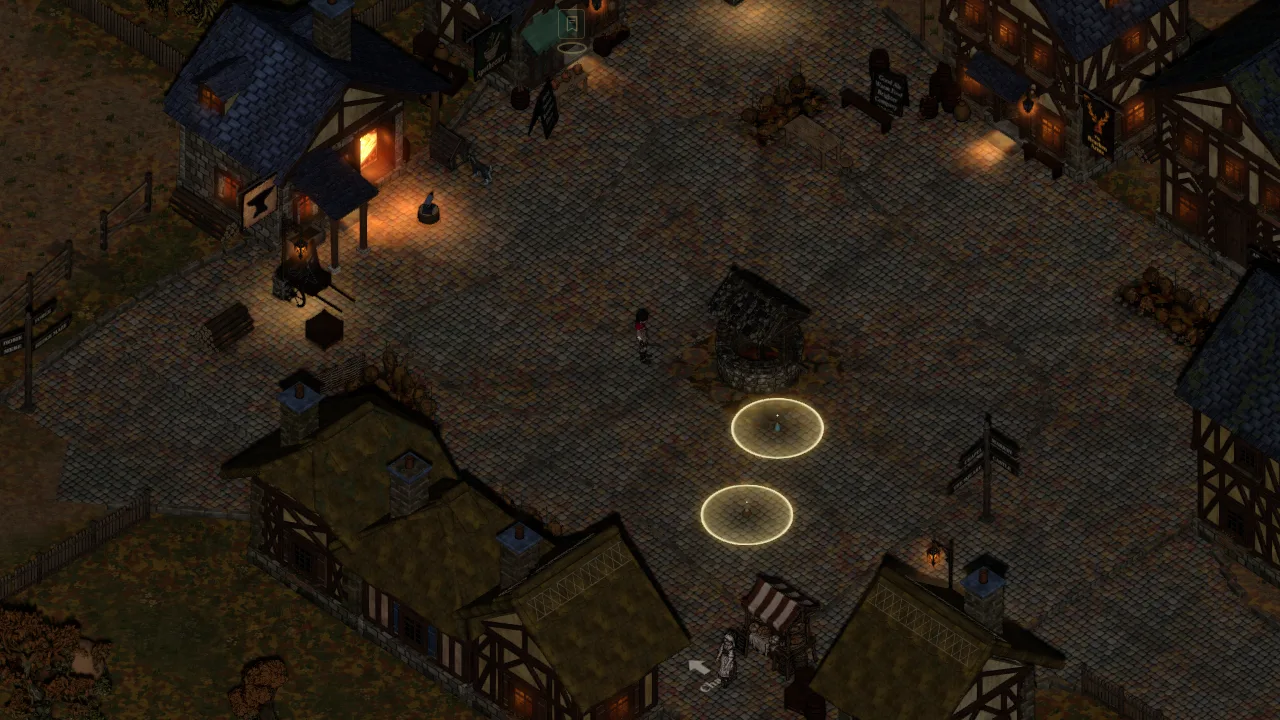 Late at night on the square. Dark, but you can still see where you are going.
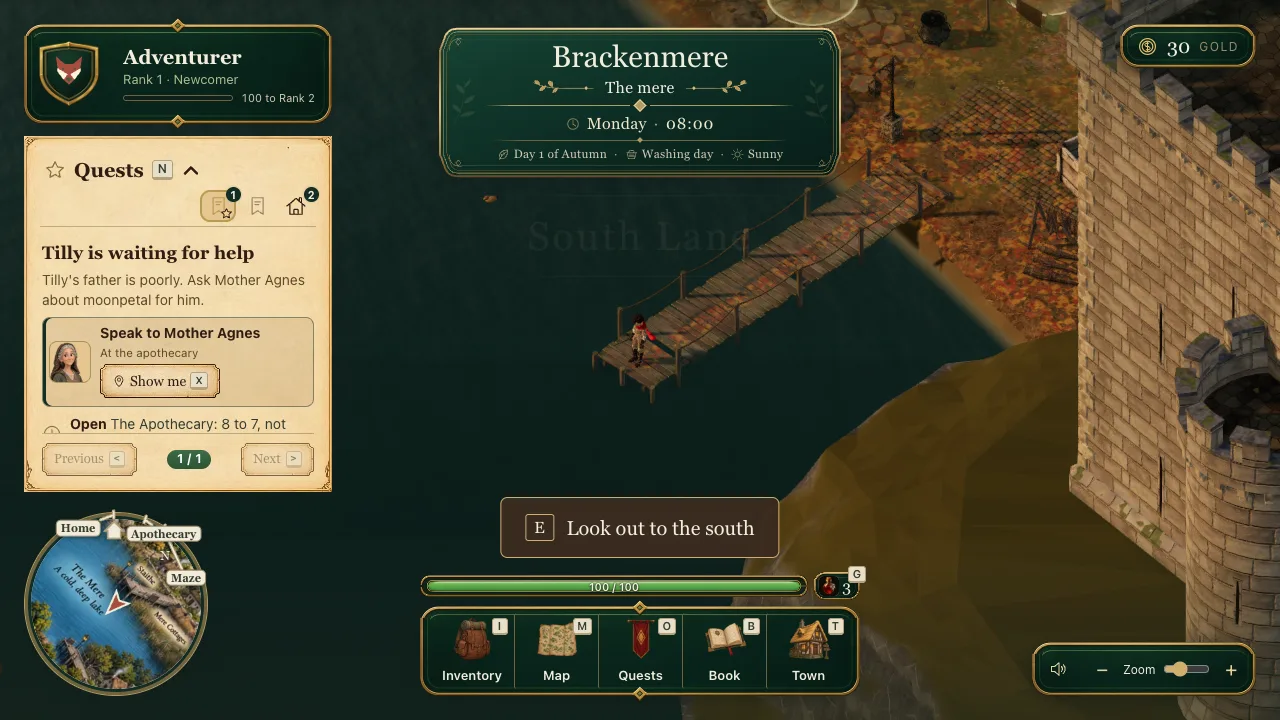 The far jetty now runs out into open water.
Sound and voices
- Music comes round sooner. The quiet between pieces is shorter, and music fades on a change of place instead of cutting.
- Everything you read is spoken. Every clue, reading and locked door that shows a line is read aloud by the narrator.
- Hunger and tiredness say what fixes them: a meal at the Arms or a bite from your satchel; your bed or a room at the Arms.
- Narration is not cut off. Lines finish while you walk or fight, and wait their turn instead of talking over each other.
- New voices. Bram's tips and reactions, Hilde's thanks for her pig, Tilly's thanks, call-overs from Elsie, Hollis and Bram, and dozens of narrator lines. Five voices could not be recorded this month, so Nan's "What key?" answer and a few call-overs are shown as text until they can be.
Touch
The iPad and touchscreen controls are in their own post: Brackenmere on a touchscreen.
Still open
A few things are mine to judge: the cape's sway, the monsters' crouching sidestep, the sit card. Two reports could not be reproduced: thin black lines on screen while turning, and a blue box in a timber yard trough. If I see them again I will grab the browser and settings. The Quests panel on a phone held sideways is only partly fixed, and five voices are waiting for next month's recording.