On the evening of 20 October I listed the maze worlds we had and asked the agents for three more: "Let's first talk together about what those 3 could be."
The atlas already held about forty places nobody had built, and the root agent picked three that would each move differently. The Drowned Abbey of Saint Brannoc, where you raise and lower the water to change the maze. Gobblestone Hall, where you are mouse-sized in a sleeping giant's kitchen. And Cinderdeep, the Makers' green-bronze halls under the mine, where rings of wall turn round a hub.
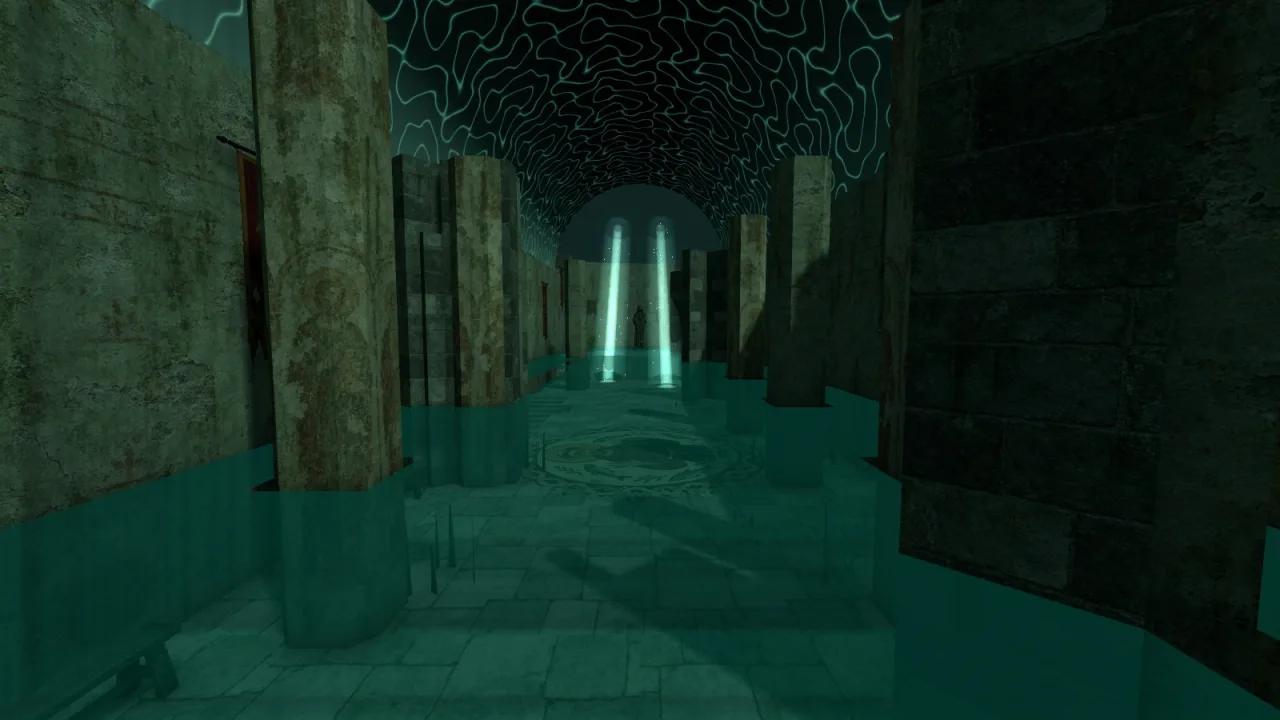 The abbey's nave at high water: the one straight run, as the plan put it, "because the builders made it straight".
"Movement. Emotion"
"Let's build those first 3 above." Then I tried to say what I wanted. "If we can help it, let's not just work on a rectangular grid, but let's work on more authentic interesting routes and paths and objects." Things should be placed "as though they had a purpose originally... if we can answer that it goes in." I asked for "AAA quality within our games feel and current artwork strategy", and finished with two words: "Movement. Emotion".
Music was mine to make. The agent wrote Suno prompts for six pieces, two per world, and warned that free-plan songs are non-commercial. "I pay for Suno." Six songs, The Giant's Snore and The Ancient Machine among them, were in the game within minutes.
One last note before I went: "For the curved layout engine, I mean it can be any shape, different angles of bends, not perfectly circular, jutted routes, angled paths etc." Then: "I am now AFK, as before, let's go."
The night shift
The plan turned that into a design bar every reviewer checked. Each world needs at least four moments where the place answers the hero, and a visit has a shape, ending, in the plan's words, with an exit that "feels like coming up for air".
First came a shared foundation. Walkable space is now drawn as shapes in metres (arcs, rings, paths that pinch and swell, edges roughened with noise) and turned into the grid that sight, chasing and the map already understand. Walls can change during play, and there are hazards, platforms that carry the hero (the abbey's eel punt), climb points, wading and a meter for each world's own pressure.
Under the hood The layout engine alone took three Codex fix rounds to pass, each counterexample becoming a test. The whole piece spent 1,246 of the 1,500 Meshy credits I allowed and about US$2.43 of US$10 of OpenAI.
Three owners then built a world each in parallel, and an independent verifier played all three end to end, in both views and on a phone: two failures first time, then eight of eight. The worlds landed on main in the early hours.
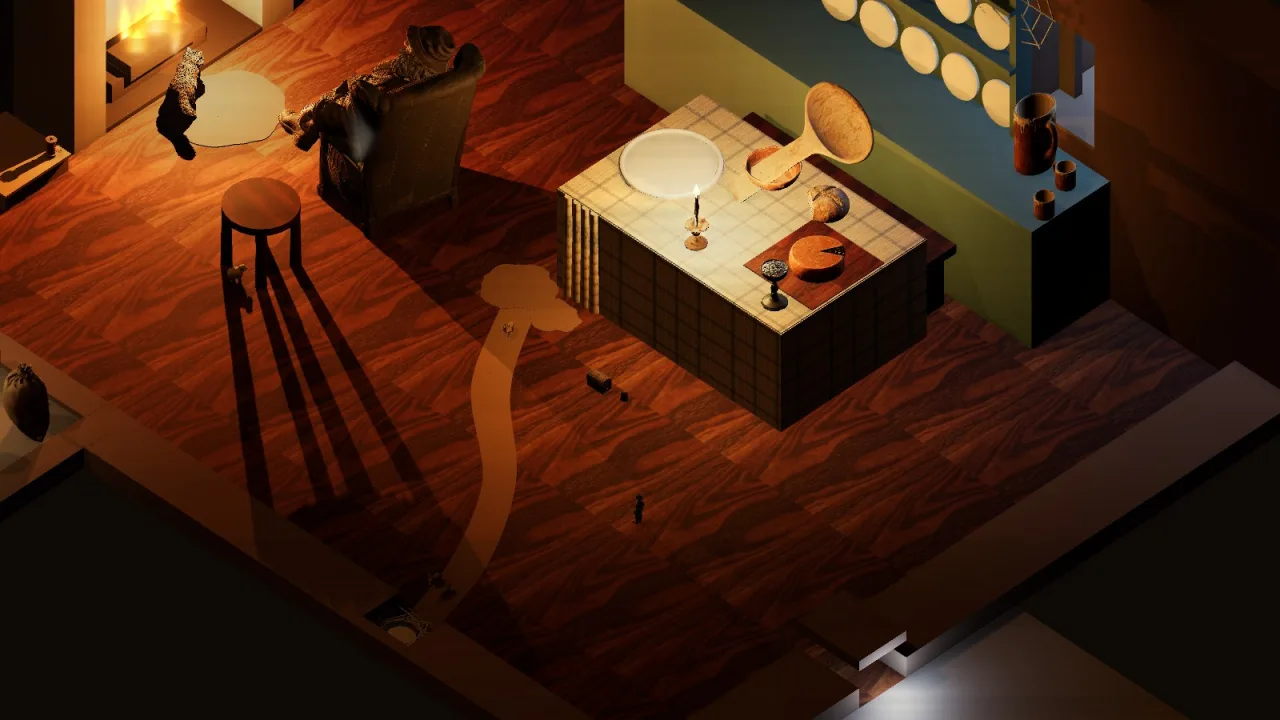 Gobblestone Hall as it landed overnight. The hero is the speck on the boards below the table.
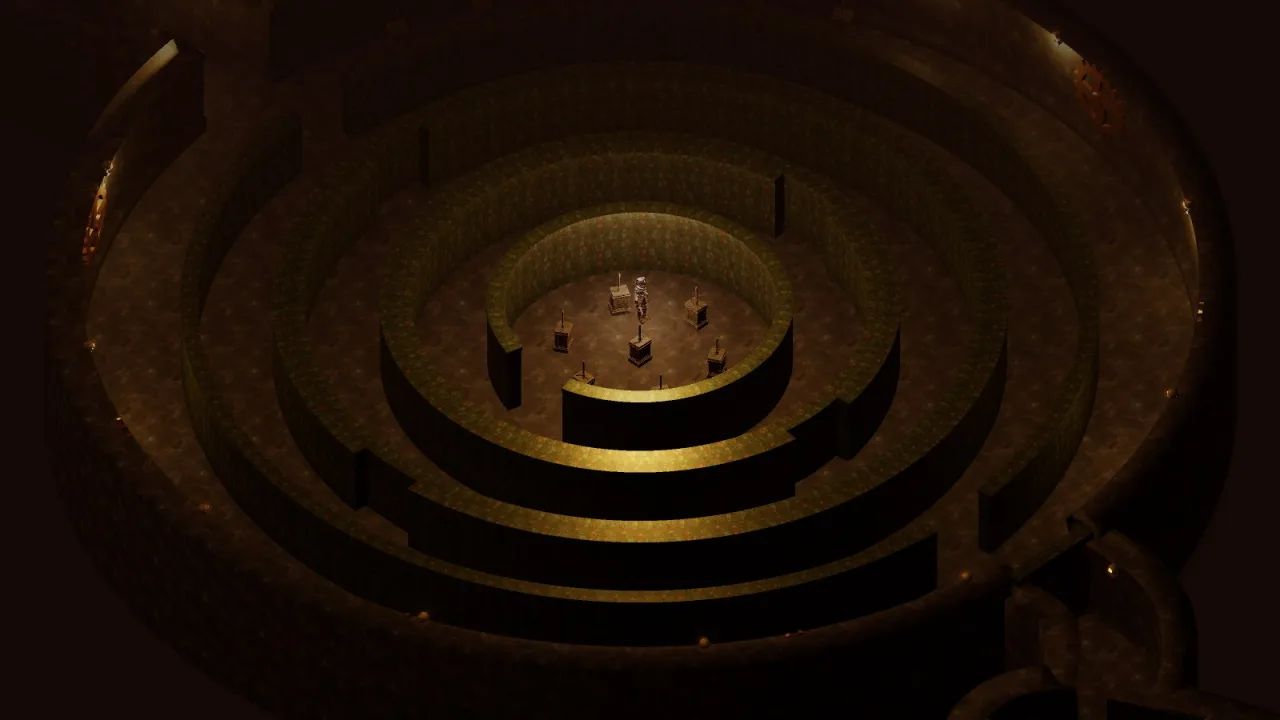 Cinderdeep's Ring Hall: turn the rings until the doorways line up from rim to hub.
Playing them
The next morning: "I had three separate agents doing lots of work last night on this game, and they've all come back, finished, and merged into main." Then I played them.
Gobblestone first. "When I went into Gobblestone Hall, although I like the premise, it's not thought through enough. In all honesty, I pushed the little reel to distract the cat, and then I wandered around everywhere and didn't know what to do." The cat caught me without my noticing: "I didn't really know that I'd been pounced on. Can we do a slow-mo like kill cam of when the cat pounces on you...?" And the mouse holes were too shallow: "If you think about how a rat would have to hide from a cat, it would have to go a lot further into the wall."
Some of it was simply broken. "This spiderweb is rubbish." In the abbey: "There's these weird floating cones. I'm guessing are they meant to be fish or something?" And "Every time I fight this choir knight, the game crashes."
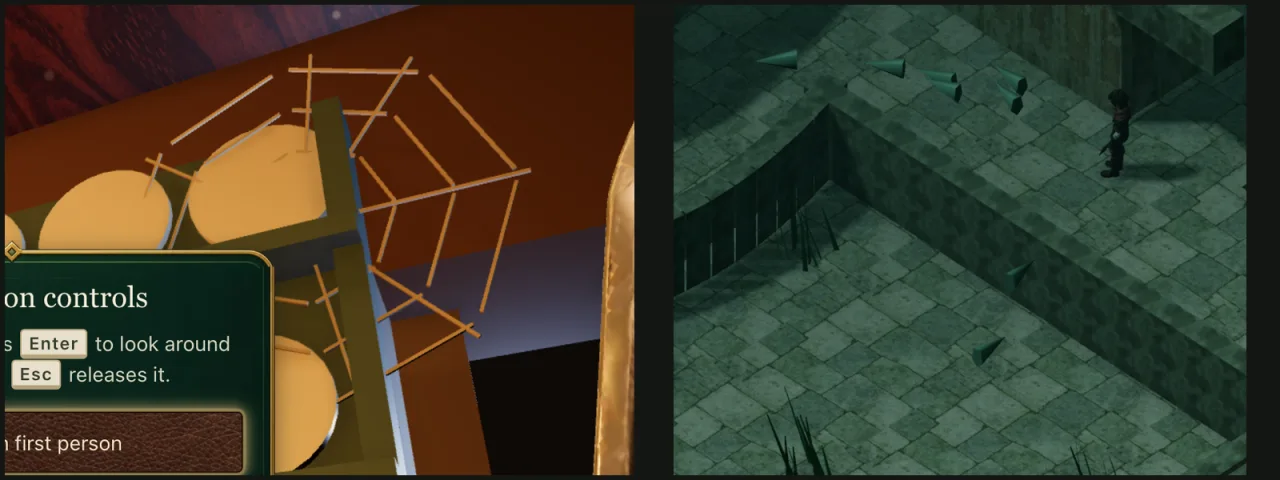 Two of my screenshots from that morning: Gobblestone's web, and the abbey's "fish".
But the abbey had moments. Of Saint Brannoc's floor mosaic: "I really really like this." I wanted more ceremony, though: "a really old tattered hanging piece of cloth, like a flag or something. Obviously it would have got wet at some point."
In Cinderdeep, "The rings are really nice", but a broken seal "is super super thin. It needs structure and weight to it." And the verdict that mattered: "I don't think I can currently complete this Cinderdeep world."
I asked for each item to be treated as a symptom: "Does it actually make sense in the real world? Like, could X be next to Y? Would the rat holes be that shallow?"
Round one: what was really wrong
Cinderdeep could be finished all along: two pulls of the middle ring line the doorways up. You just could not see what a pull did. Each ring's two levers now stand together with a plaque naming the ring.
Under the hood The Hall Sentinel kept vanishing because every prop, even a knee-high mine cart, blocked sight like a full-height wall. Of 41,022 pairs of points a metre apart in the upper hall, 6,979 could not see each other; after the fix, none.
In the abbey, the main outline was traced the opposite way to what the wall builder expected, so about 290 metres of wall had been built as 5 cm slabs: the see-through blocks and paper-thin stair guards in one mistake. The cones became Meshy perch that stay in the water and drain with it, and a tattered banner and a fallen monk went in.
Gobblestone got a cat with a brain. He watches the crumbs where the mice run, turns towards noise, chases at a pace a child can escape, and his pounce plays slowed down from beside the hero.
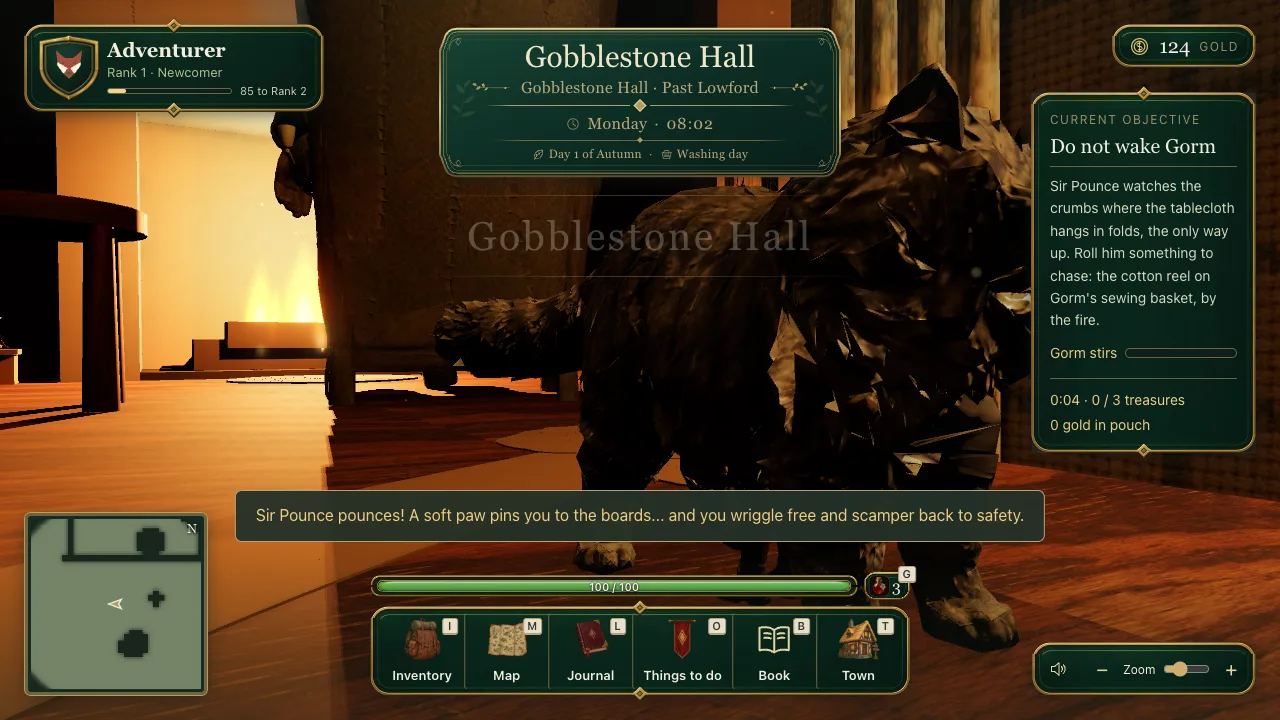 The pounce, slowed and told, so you know it happened.
I had also said Gobblestone's walls were "bare and kind of perfect", so its owner built surface wear (damp, cracks, scuffs, soot) once, as a kit piece any world can use.
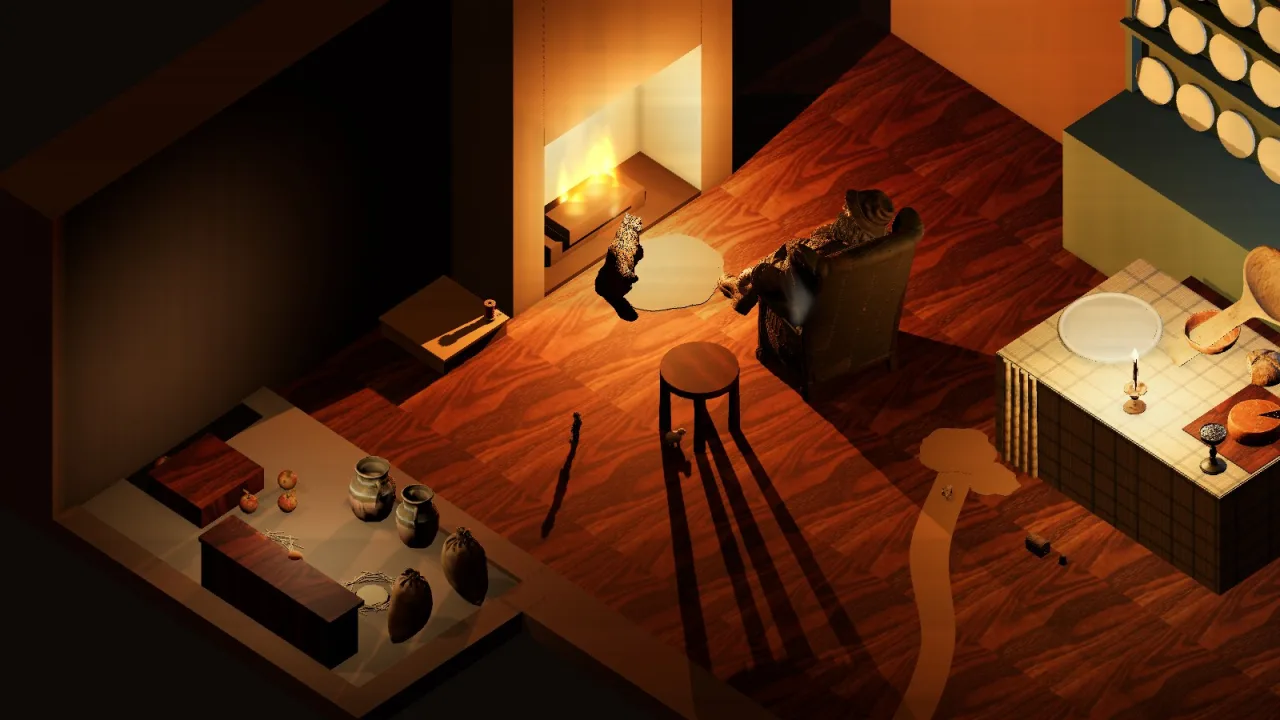 The hearth corner as it landed overnight: bare walls and the mice's trail as a painted ribbon.
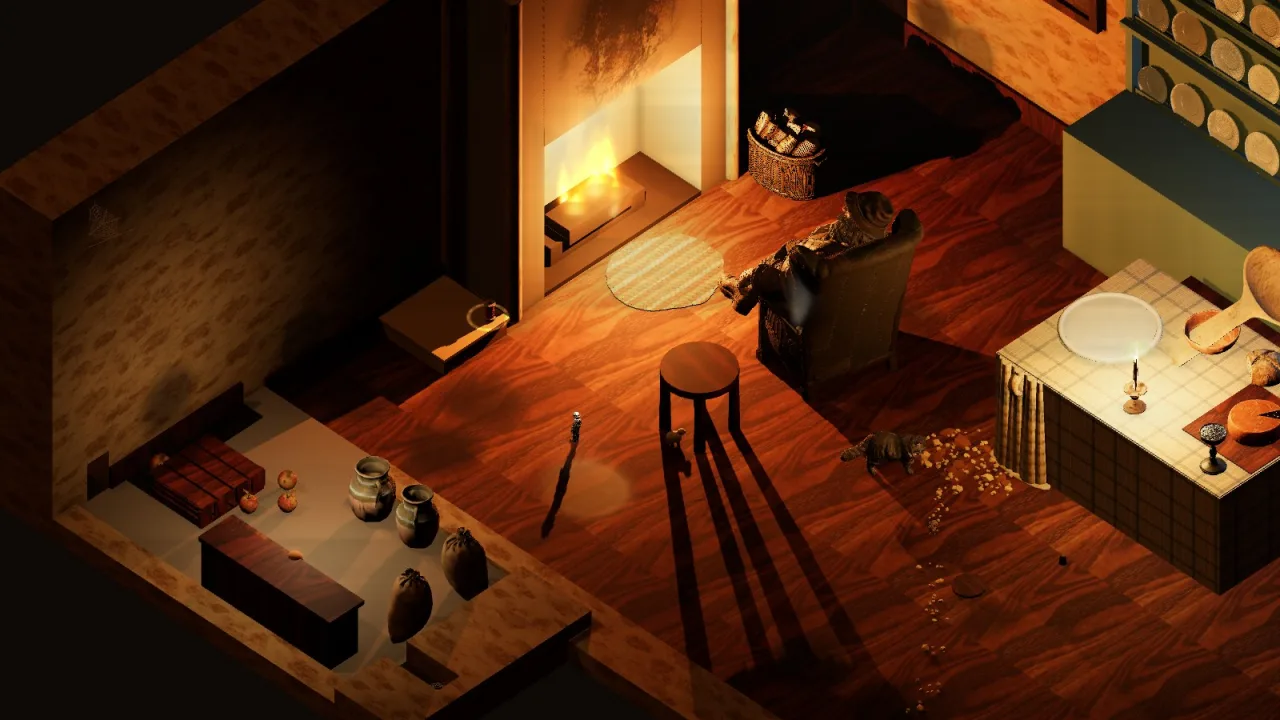 Same view, after two rounds: plaster and soot, a log basket, real crumbs, and Sir Pounce moved to watch them.
Round two
Root then sent a checker to play all three on the merged main. All three could be finished, but it found seven new problems. The abbey's objective said "Find your way through the drowned abbey" from start to finish, and Cinderdeep's levers said "sunwise" and "widdershins", words that, in the checker's report, "a child won't know". So the abbey and Cinderdeep got step-by-step objectives like Gobblestone's, the levers now say left and right, and a hero hiding under Gobblestone's bench glows through it. Round two was merged by lunchtime.
What I took from it
One night was enough to build three places where, as the plan asked, every object could answer "why is it there?". What the design bar did not cover was a player in a beautiful room with nothing telling them where to go. Every review passed that. A goal you can read beats a better cat.
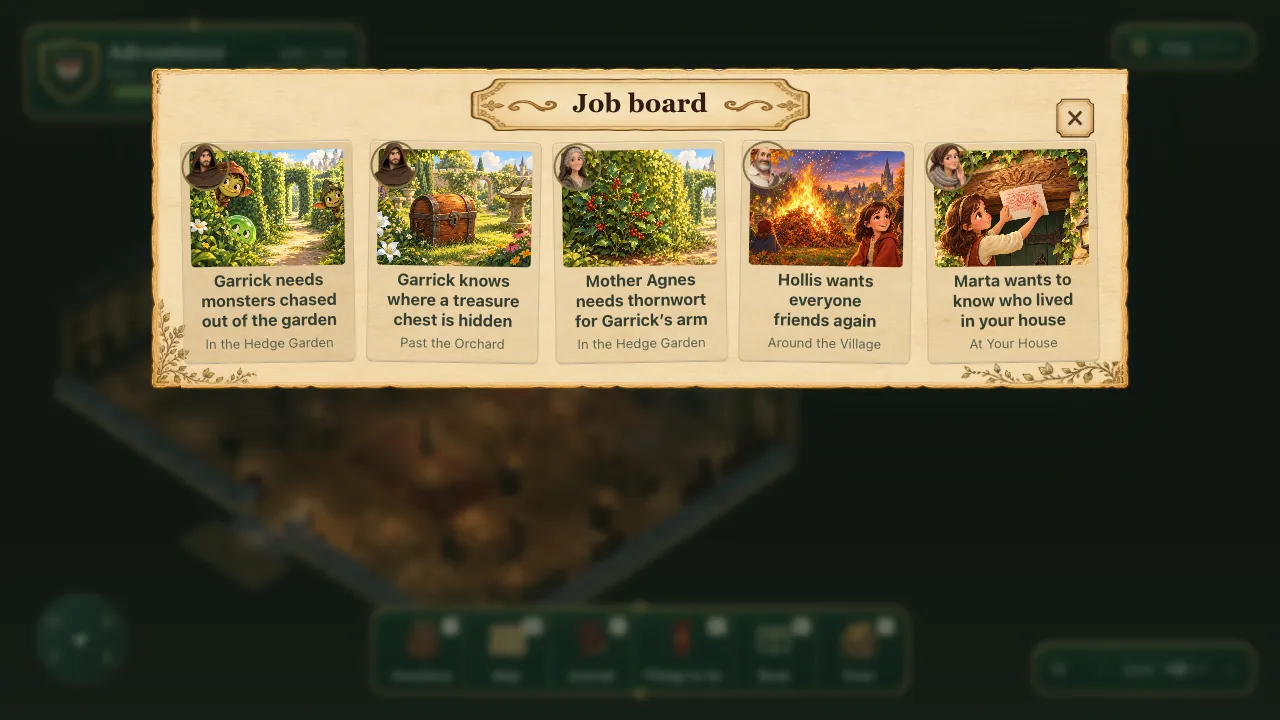
There was a bigger gap too. That same morning I opened the quest ledger and saw it: "Right now I can't see that any of those are in this kind of playable quest." Three new worlds, and no story yet that leads you to them.