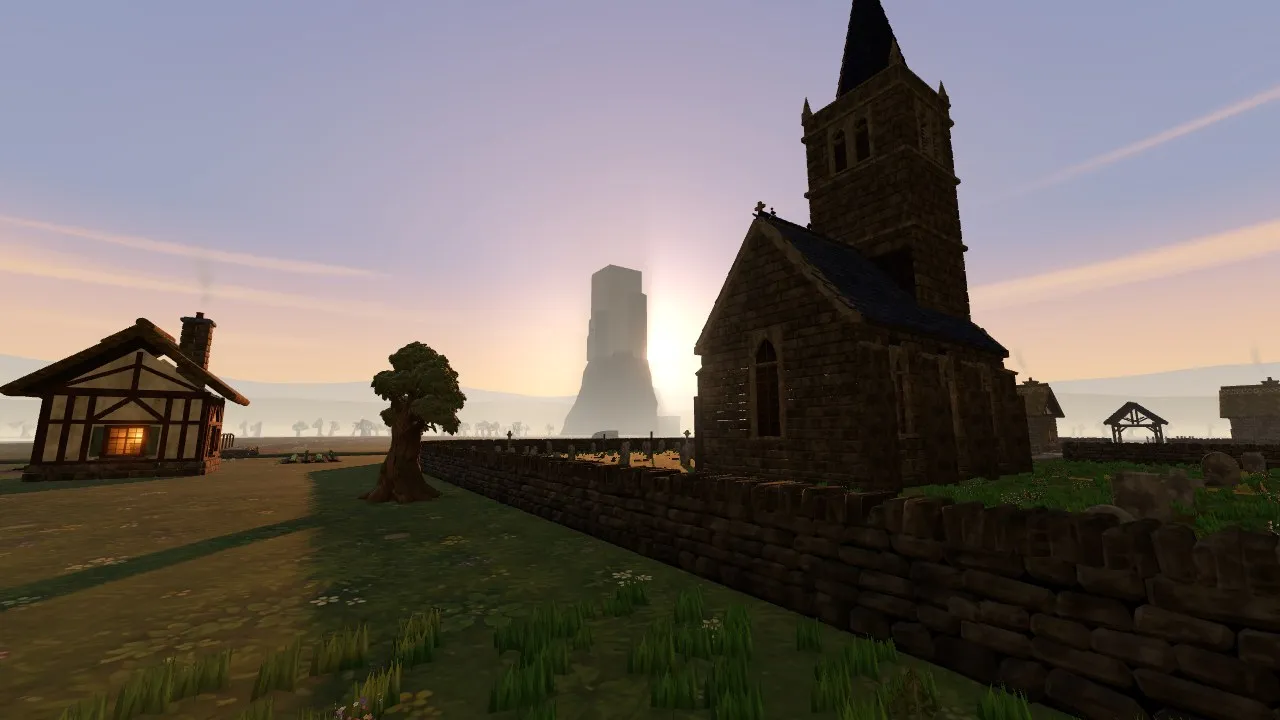
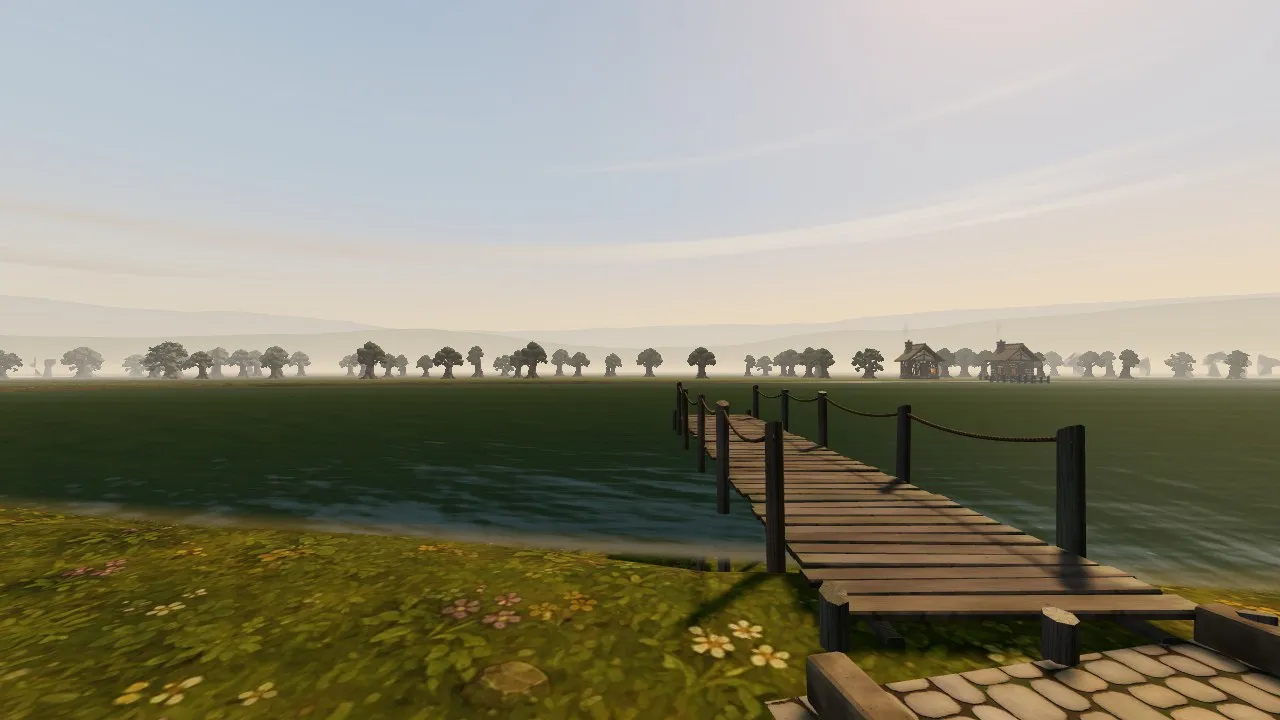
By 9 October Brackenmere looked the way I wanted, but walking the village in first person, it hitched.
That evening I gave the agents the job in one long dictated message: "I want you to go through the whole gameplay experience here and figure out ways of making it more performant." I was clear about the trade: "preloading stuff in the initial game loading is fine, like as long as like we show like Brackenmere is loading the assets. And if that takes a minute before the game starts, that's okay. I'd much rather that than things be jolty or buggy during the game."
And I asked the question that had been bugging me: "I can play Quake 3 in the browser. How does that work with such, with no lag and such smoothness to it all? There must be something going on here, because... definitely our textures and details aren't as much."
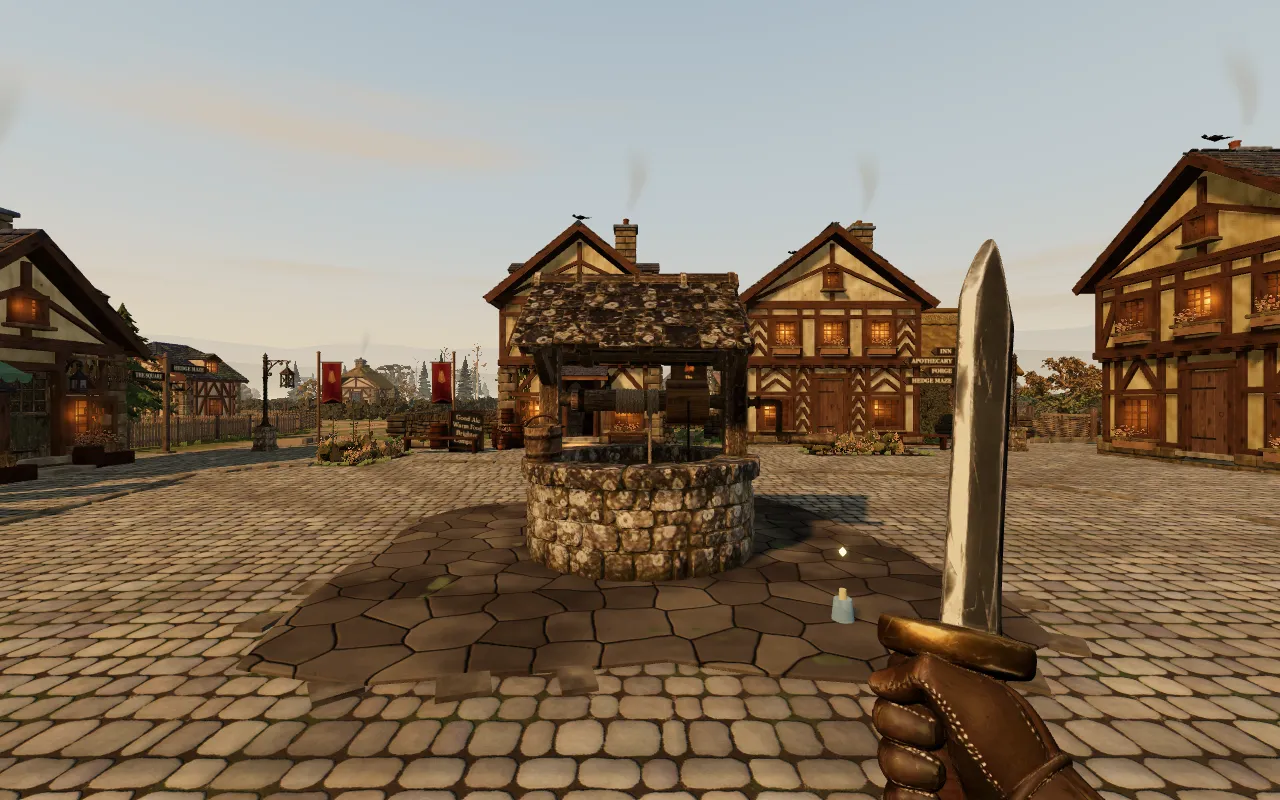 The square at the well, rendered from the final build of pass 4. The art did not change; the cost of drawing it did.
Four passes, one at a time
I wanted one agent to investigate, plan, build and measure, then a completely fresh one to start again from its results: "let's see how far we can push these performance improvements." I checked the process first: "Does that go through any review rounds, etc.? And then when does... you start another... agent? Like, what's the kind of process here?"
Each pass got one independent review and had to prove itself with numbers. Then I handed it over: "ok im off, its all yours."
The first two passes ran overnight on Codex. They went after hitches: shadows that rediscovered the whole scene every frame, and materials that compiled the first time you swung a sword or the weather turned. In the morning I asked for "a morning rundown. Whats happened? Pass 2 has finished. Give me before and after stats." The jolts at a weather change had gone. Walking in first person was no smoother.
Under the hood The worst frame when night rain rolled in fell from 154.5 ms to 14.9 ms, and the first sword swing from 57.1 ms to 14.7 ms. A steady 60 needs every frame under 16.7 ms.
The machine was not as quiet as I said
I had told them "You're the only thing running on this machine." I was wrong: a macOS media-analysis service started up during the runs, eating CPU cores and GPU time. The agents spotted it, marked those timings as contaminated and kept only numbers from quiet windows.
What actually cost the frames
Passes 3 and 4 ran on Opus later that morning, in Claude. The first finding was blunt: the village was limited by the graphics card, with too many pixels to fill at Retina resolution.
The Quake 3 answer fell out of that. Quake 3 baked its lighting and visibility into the level offline, so none of it ran per frame. Brackenmere was paying at runtime for things nobody could see: ten street lamps switched off by day still ran their lighting maths on every pixel, and every fern was drawn on its own.
Under the hood With vsync off, a first-person frame cost 24.0 ms. At a quarter of the pixels it was 14.8 ms. Ferns alone were 459 of 1,371 draw calls; batching them took the frame's draws down to 960.
So the passes removed work that changed nothing on screen: lamps that are off are skipped, ferns are drawn as one batch per chunk, merged meshes share their corners, shadow taps are compared in hardware, and the far land loads behind the loading card.
Each was checked by rendering the same frozen frame from two builds and comparing pixels. If the picture changed, the change went, even when faster.
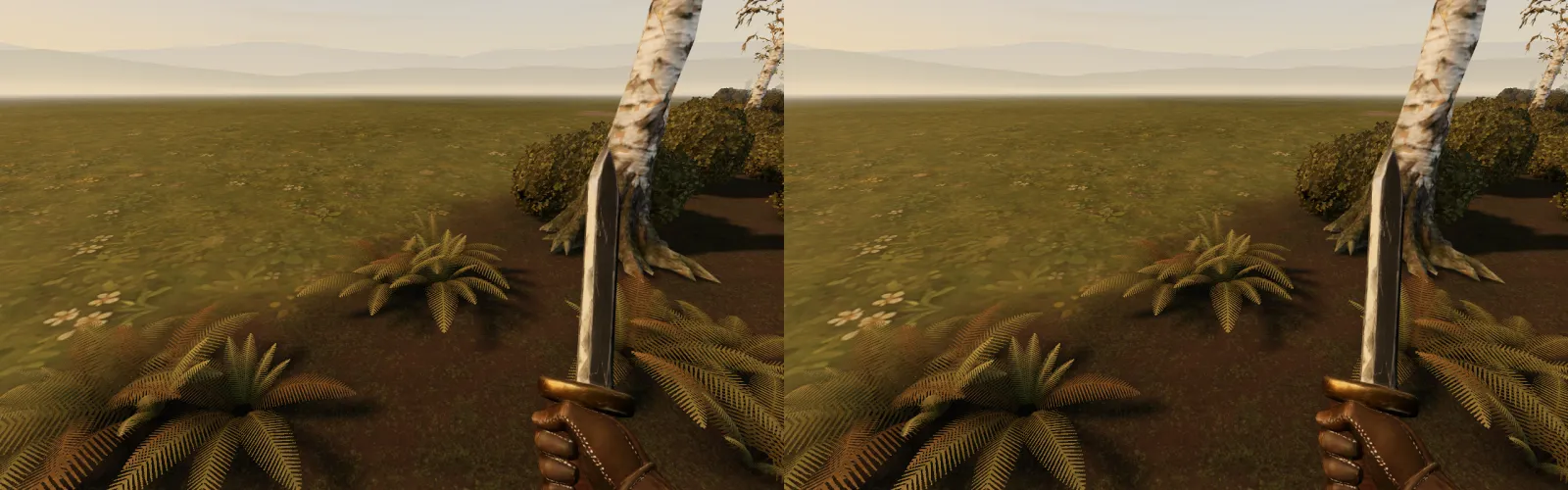 The pixel check for fern batching: the same frozen frame from the build before and the batched one. One draw per chunk instead of hundreds, and the same picture.
The limit
After four passes the overhead view barely missed a frame. First person at High still missed a third.
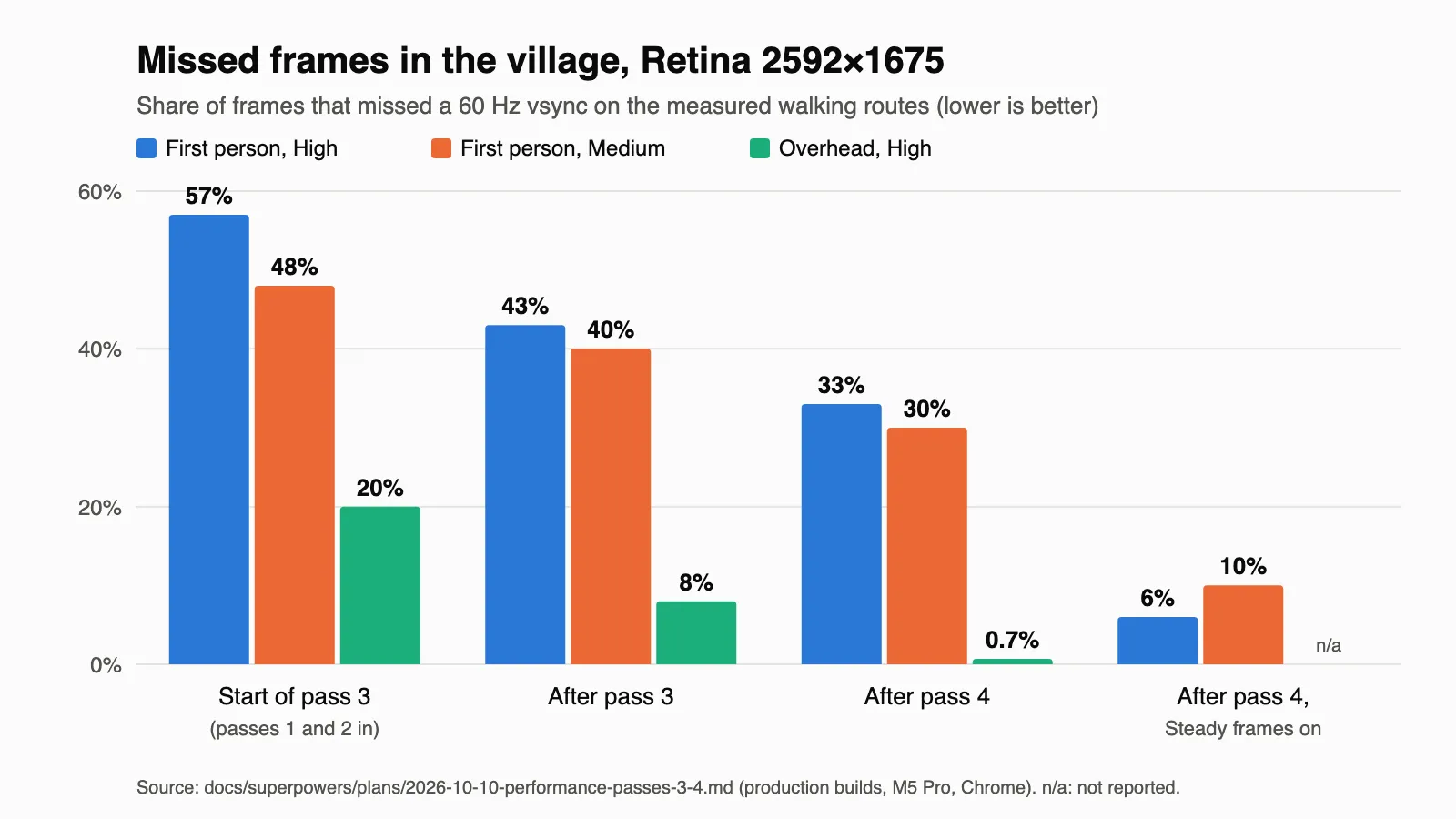 Missed frames on the measured routes, from the plan's tables. The last group is Steady frames, the option I turned on.
Both owners had written the same warning before building: a steady 60 in first person at High needed about a quarter less GPU work than any picture-identical change could find. The rest had to come from the picture itself, and that was my call.
Under the hood First person went from 24.0 to 21.25 ms a frame across passes 3 and 4. What was left was attributed: 4.9 ms of anti-aliasing, about 2.5 ms of sun-shadow sampling, 3.8 ms of the craft wood and stone.
My choices, honestly made
The agents came back with a list. My first reply says a lot about building a game this way: "I like the steady frames journal option, but Im not 100% clear what its doing / the downside / The anti-aliasing msaa - again no idea what this is or whether Id notice / Shadow samples - again confused."
In plain terms: Steady frames draws fewer pixels for a moment when the game falls behind, softening the picture instead of stuttering. MSAA smooths jagged edges by sampling each pixel several times; we used four, and two cost much less.
Five minutes later I had decided: "Steady frames, lets implement / Lets try 2x, change it to that / Shadow samples - lets leave for now if its minimal." For the models: "The big models seems like not a lot we can do here now, and we might use those animations so leave for the time being."
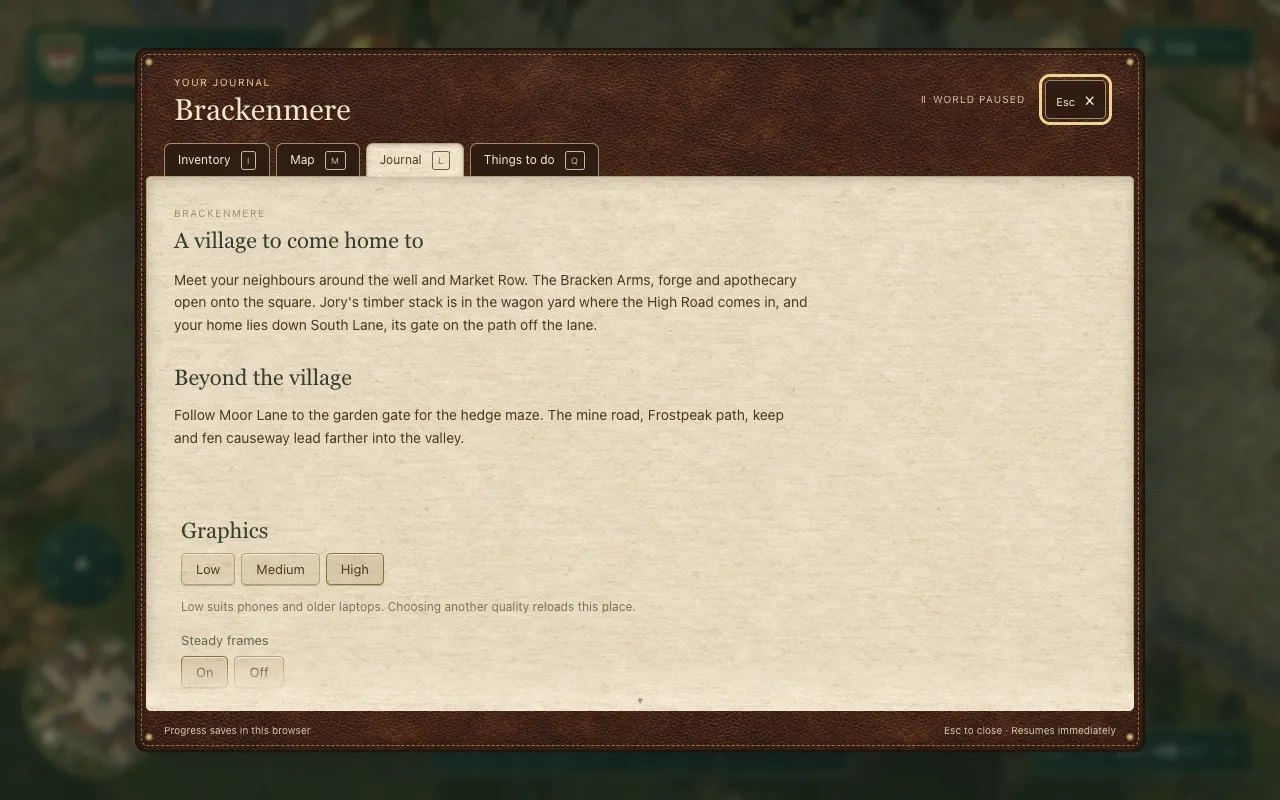 Steady frames in the journal, on by default from 10 October.
With Steady frames on, first person at High missed 6% of frames instead of 33%.
The shadow clock, tried and taken out
The day before, I had tried a fix of my own. Our days pass quickly, so fence shadows sweep across the grass as you watch. "It's not a bug. It's true. The sun is moving... I don't want to kind of complicate things, but it's really quite off-putting when you're playing."
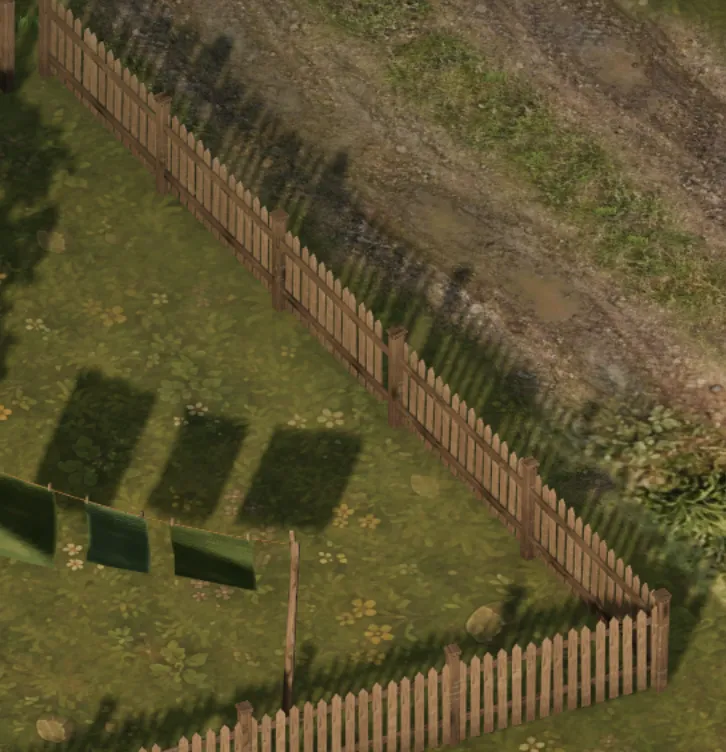 The screenshot I sent on 9 October: thin pales, close gaps, shadows that crawl as the sun moves.
An agent researched it and I said "let's build what it suggests so we can check this out." The sun's light moved in small steps, with a switch to compare. The crawl stopped, but every few seconds every shadow jumped at once. I kept the continuous sun: the cure was worse than the symptom, and the switch let me find that out by looking.
Only download what changed
One more thing came out of that list. "Otherwise Brotli compression I can turn on, and can we add long cache lifetimes?" and then "Build the asset fingerprinting and nginx block."
Every shipped file now carries a hash of its contents in its name, so a browser can keep it for a year and a returning player downloads only what changed. The agent wrote the nginx block for me to apply on Forge.
Under the hood A warm reload fetched one file over the network, the page, and took the other 452 from the browser's cache.
What I took from it
Optimisation has a floor you reach honestly. Once the invisible work was gone, the only levers left changed what you see. I did not need to know what MSAA was to make that call; I needed an agent to tell me what I would lose.
I used it again the next morning, planning a flyover for the new opening, I added: "we can go low quality for the flyover, pause the time of the day so we aren't re-computing flyovers, and not have characters in it."