The last changelog ended with the list from 2 November. The graphics settings have their own post. This one covers everything since then: the afternoon of 3 November to the evening of 6 November.
It began the same way as before. I played, and wrote down what felt wrong. On the afternoon of 3 November the list ran from a to s. On 4 November it went from a to y. Then, on the morning of 5 November, I asked for something bigger:
"Can you go through every single quest we have in the game? I just want to make sure that we don't miss anything here and make sure that everything is covered, and there's no kind of strange anomalies of things that happen."
The answer came back as a very long, very thorough document. "This is good as a really detailed note, but it's almost too much information for me to take in and read," I said. "This is useful in other ways, so it's been a useful exercise here. Keep this for now, but let's fix the issues." Fixing them took most of that day and night, and it is the biggest part of this list.
Like last time, this post is about the game: what you see, hear and do. Performance gets one short section at the end.
Under the hood The four days came to roughly twenty pieces of work, each built in its own worktree and reviewed until a review round came back clean. Most of them ran overnight while I was asleep, under an agent acting as orchestrator on my behalf, with my morning notes folded in after.
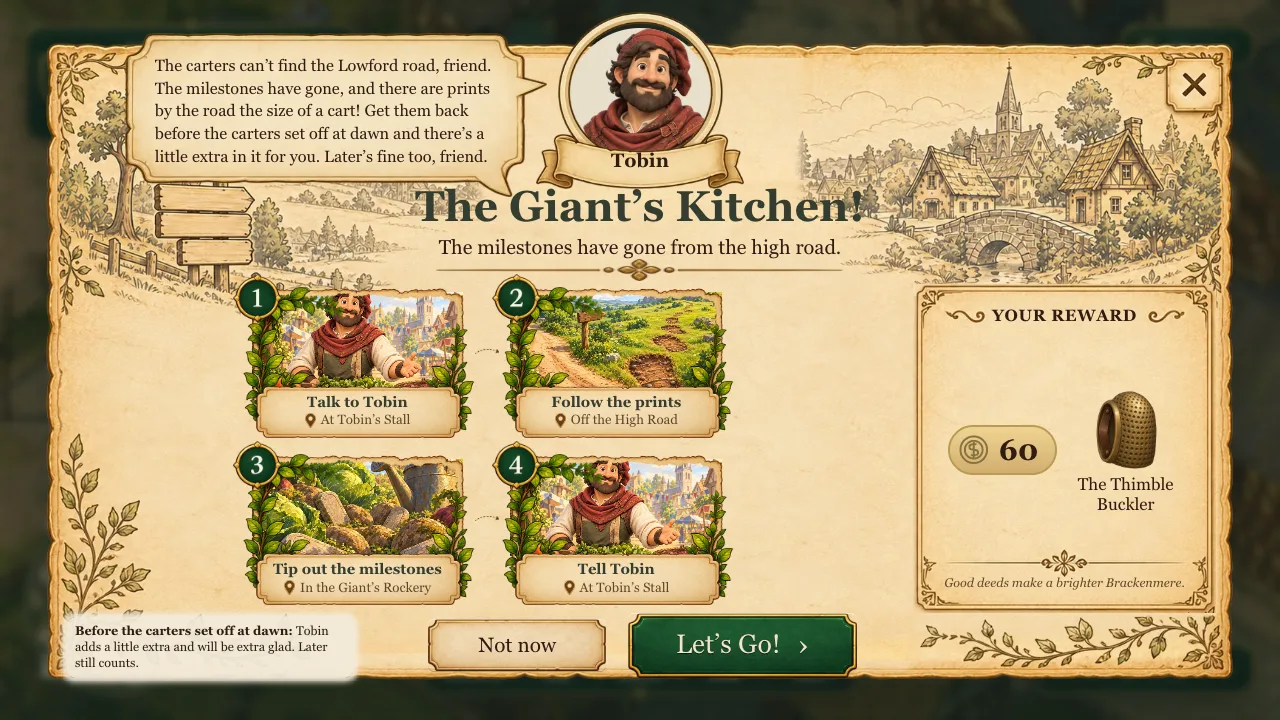 Tobin's errand comes with a time. The note in the corner says what being on time earns, and that late still counts.
Quests that finish properly
The quest read-through found the same kinds of problem again and again. A reward handed over somewhere other than where the quest was given. A cut-away played at the wrong moment. A step note saying "everything for the fever draught" when you still had no water.
- Quests end where they began. A quest someone gives you now ends by going back to that person. The return is written and voiced, and it ends on the Quest complete card. Finishing the job out in the field no longer hands you the reward on the spot. (Discoveries, escorts and little happenings still reward you where they happen, because there is nobody to go back to.)
- Scenes play at the right moment. A hand-in's short cut-away plays when you actually hand the thing over, not later, when you go back for the reward.
- Replies come in order. "I think buy, sell and learn potions should always come up top," I said. "Underneath that, the quest thing should always kind of be on top and also on the first page." That is now the order with everyone.
- Step notes say what is still missing. Picking up the last moonpetal tells you that you are ready only if you also have the water. Otherwise it says what you still need, and where to find it.
- The quest you chose stays chosen. The quest you are following no longer swaps itself for another one.
- Every goal takes a moment of work. Claiming a goal is a short action with its own words, such as lifting, prising or reading, not a click that is over before you notice it.
- The crypt's end can't be missed. One morning I asked: "I just went through it all and it didnt complete it when I got to the end?" A minute later: "oh i didnt trigger anything, i just walked to the end and went out." The quest was fine. The game had let me walk straight past it. Now the goal wears the green quest ring, the step reads "Look at the tombs at the end of the crypts", and the way out asks first.
- Leaving early asks first. Walking out of a quest area with a step still to do names that step and asks if you really want to leave. Stay lays the trail back.
- Step text ends with the deed. Quest steps are worded so the thing to do comes last, where your eye lands.
- Discoveries sound like discoveries. A secret you find has its own short sting, not the quest fanfare, and its card says how you found it, with the find's picture in place of a face.
- What you fix stays fixed where you can see it. The fallen tree on North Lane is sawn into rounds and stacked on the verge, Jory's cart is back on its wheels, and the lamb stands in Hatherley's yard, not on Kate's spot or in the fence. When you walk away and come back the next day, they have been tidied up properly.
- The pig goes in through the gate. The Bracketts' pig runs to keep up with you, goes into a wattle pen at the farm through its open gate, and you shut the gate behind her. She no longer vanishes, and she no longer climbs through the fence.
- Bun waits to be asked. Lost Bun only follows you home once you offer to walk him there, and his thanks happen at the well.
- Jory's cart breaks when it should. It only breaks once he is over his fever, and he waits by it on North Lane during the day. At night, or before he gets there, the cart tells you where he is.
- Madoc's tray. While his tray is open, Madoc talks about it and thanks you for buying. He never says "not for sale today" over an open tray.
- The anvil puts the quest first. A quest's recipe sits above the gear upgrades and drops off once it is made.
- Deliveries count what you carry until you hand it over.
- Garrick's hedge maze needs twelve monsters cleared, and there are always enough about to find twelve without a long hunt.
- Errands pay sensibly. A village errand pays a set amount plus a little for each thing you bring.
- The silver heron is never lost. If you miss the bonfire, Agnes asks you about the knife on a later visit.
- New pictures. Quest finds, good deeds and the Book's news all have their own pictures now.
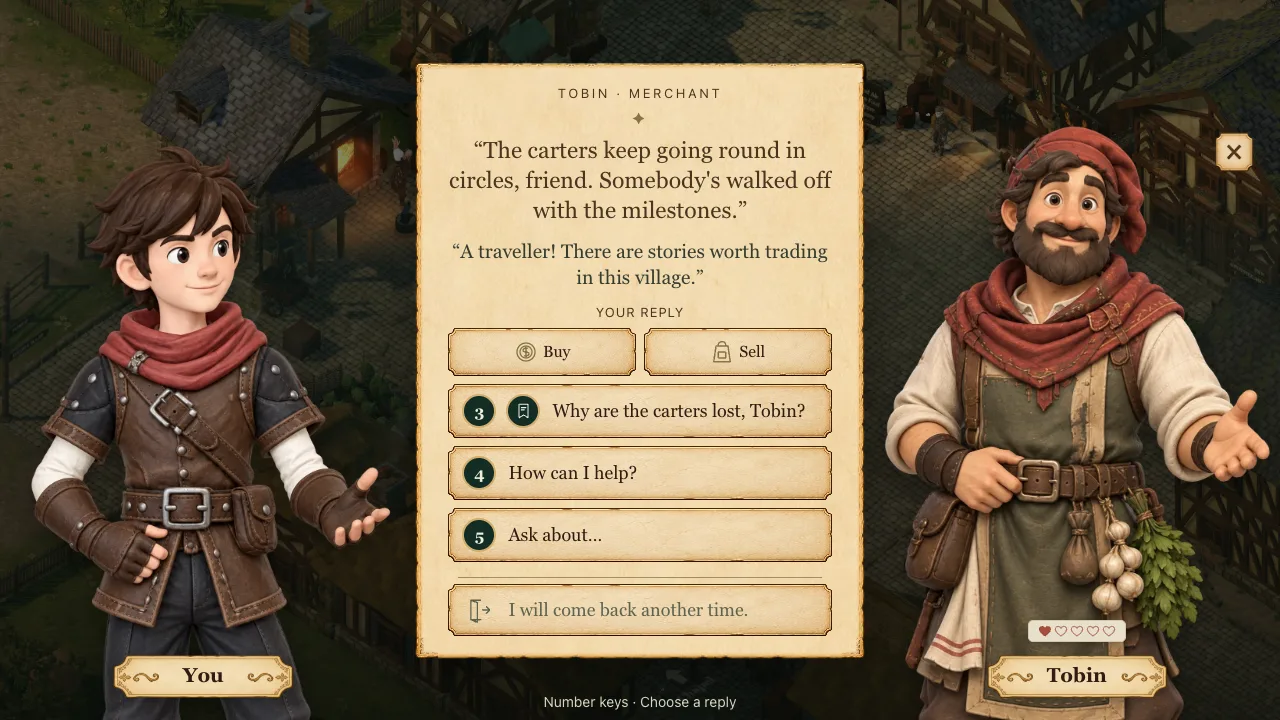 Buy and Sell first, then the quest, all on the first page.
Errands with a deadline
Errands are the small jobs people ask of you. Six of them now have a time attached. Marta wants her marbles out of the well by this time tomorrow. Tobin wants his sack back before supper and his garlic from the Reach within two days. Garrick wants the garden thinned out before dark.
When I first saw this, every errand had the same few hours. "Time moves pretty quick in the game, so three hours might not be enough," I said. "We should have some idea of how long the quest might take, and then work it back from there rather than having a set three hours." The same went for who asks and when: "If you ask him fairly late on, then he should give you till the next night or something. And the lines would have to be wrote appropriately depending on when you ask them."
- The giver says when. "Before dark, if you can", or "before dark tomorrow" if it is already late. Each errand knows roughly how long it takes, so you are never given an evening for a job that needs a day.
- A sand-glass counts down. A small chip with the hours left sits on the errand in the Quests panel and on the line at the top of the screen.
- On time pays a little extra. A fresh loaf, a potion or a few coins, and a warmer thank-you, with "Right on time!" on the reward card.
- Late is still fine. You get the normal reward and the normal thanks. Nothing is ever failed.
- Sleep asks first. If a sleep, a rest or an hour on a bench would carry you past a deadline, the game asks first: who has something for you, and when by. Not yet keeps the clock as it is.
- You hear once when time runs out, never as a surprise when you load your game.
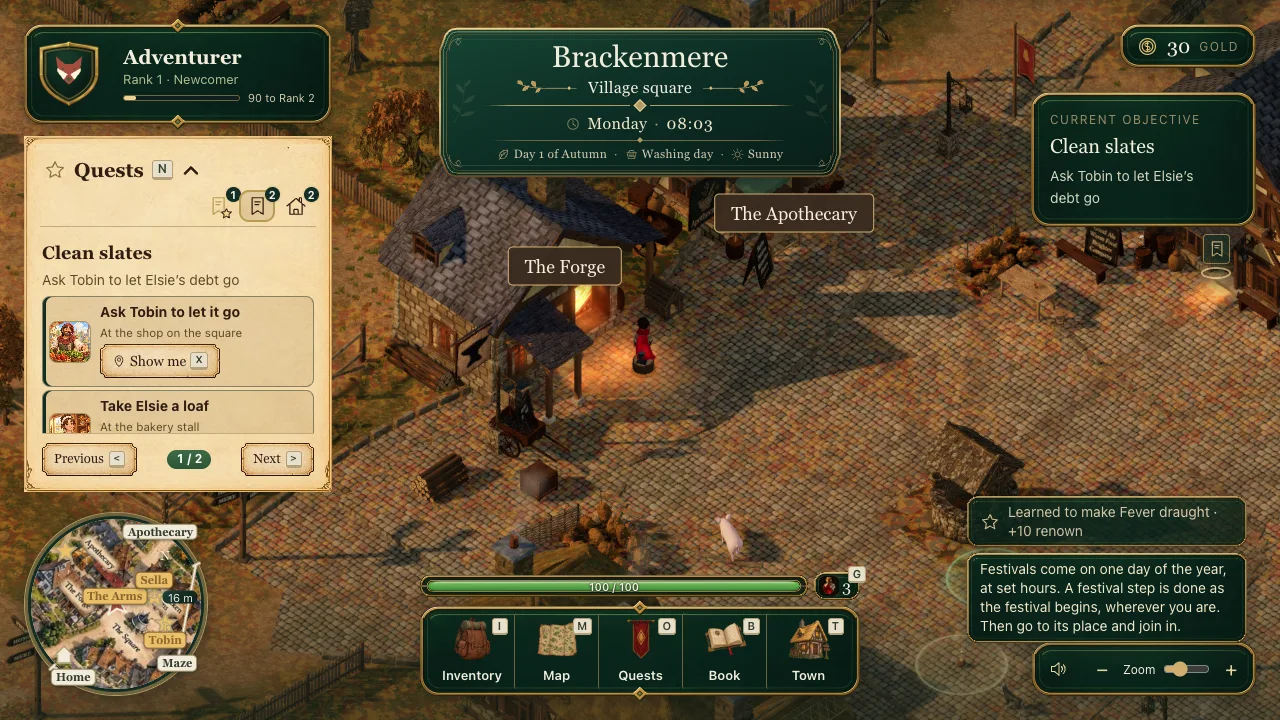
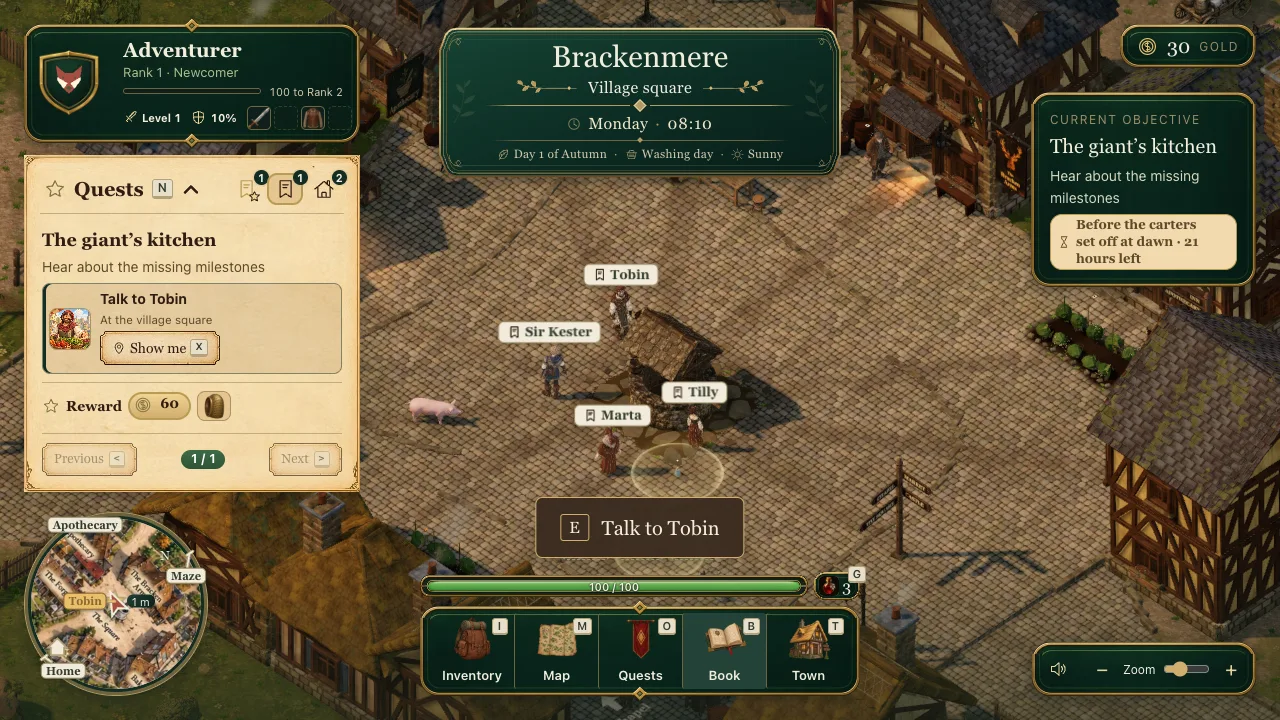 The sand-glass on the objective card. Up in the corner, the hero card's gear row shows level, defence, and the sword and jerkin you're wearing.
New faces, and every face redrawn
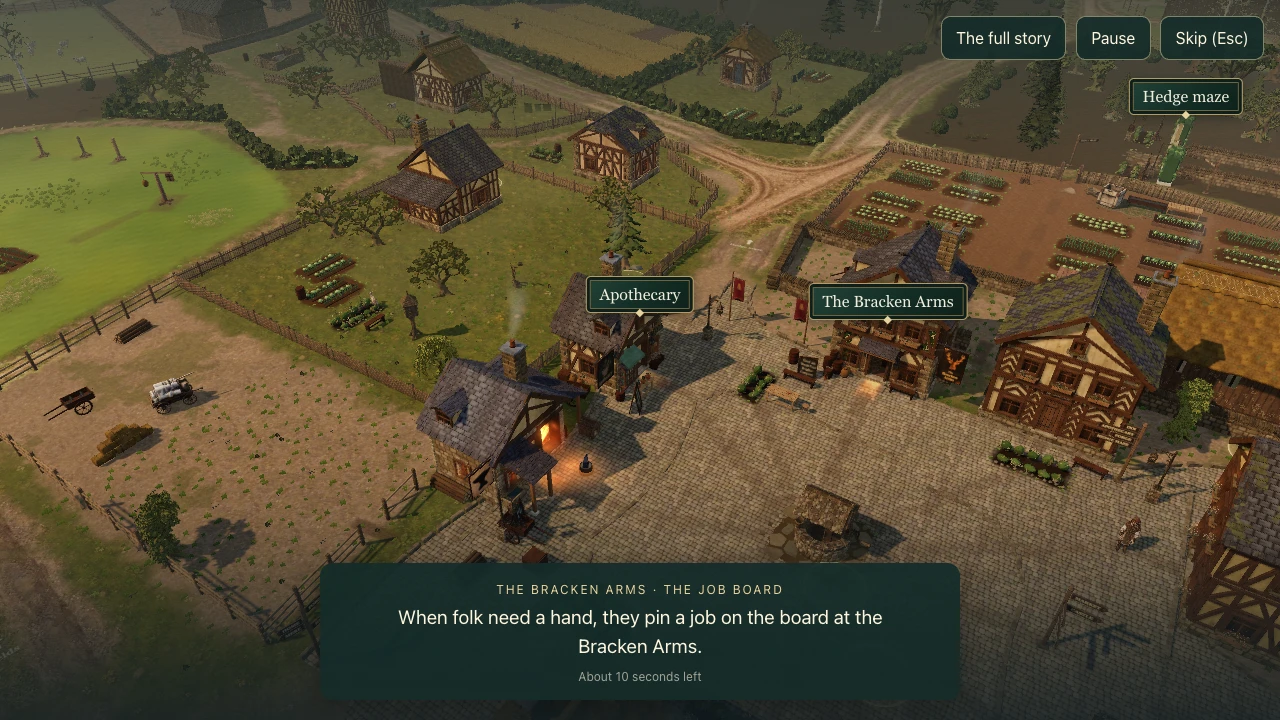
- Sir Kester Vane has taken room four at the Bracken Arms. He is a knight down on his luck, fully voiced, with his own quest, Kester's Debt, and a letter he writes on Sundays. At the Bracken Burning he sells one family heirloom a year from the Vane arms stall, in order: a sword first, then a shield, then a breastplate.
- Crispin Ledgard, the reeve's clerk, sits in a booth at the Arms. He arrives in the autumn, and older saves catch up. His lines are written but not yet recorded.
- Tuppence the sheepdog lives at Hatherley farm with Kate.
- Jackdaws peck and hop about the old bailey, fly off when you come close, and drift back one by one after you have gone.
- Every townsperson has a new body, remade in the style of their conversation portrait, so the person you talk to looks like the person you see in the street.
- Feet on the ground. On a slope, a villager's hip drops for the lower foot, so nobody floats on a hillside.
- No more black shawls. The weather wraps on townsfolk drew as black slabs on the new bodies, so they are gone.
- Reverend Edric's portrait no longer has a chapel painted behind him.
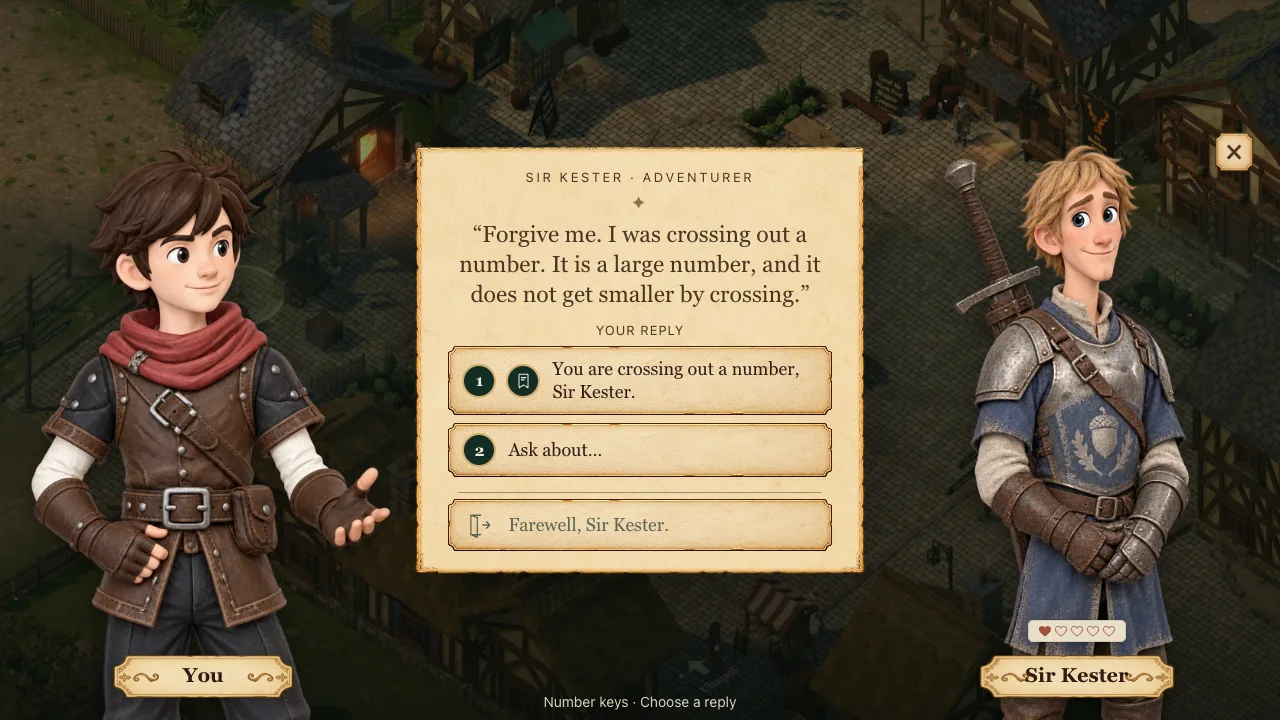 Sir Kester Vane, and a number that does not get smaller by crossing.
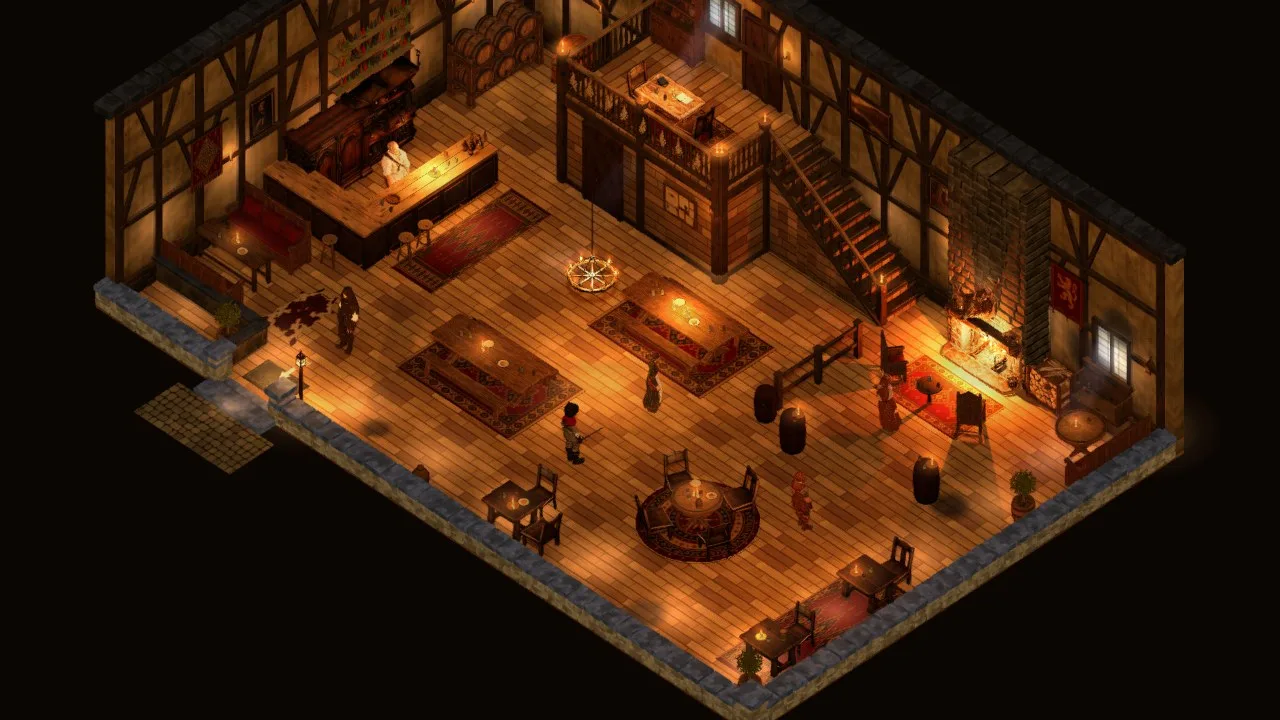 The Bracken Arms, where Sir Kester has room four and Crispin keeps a booth.
Remaking the bodies took a few goes. The first fixed versions looked better but were much bigger files. "All I want to do is get rid of a few grey lines here, say for Katherine, and maybe there was a slightly different eye version, but that shouldn't be adding that amount," I said. "You should be able to create the same person with exactly the same file size." So we worked on Katherine alone, side by side with her old self, one camera moving both, until she looked right at the same size. "Yeah, Katherine passes. I think this looks good." Then all the others went through the same recipe.
The town keeps better time
- No more vibrating. "At the moment people get stuck and they just kind of vibrate," I said. "This also happens with walls in the wood when they can't get to you because another wall's in the way." Now a walker or a monster that is blocked waits for the way to clear, or goes round.
- You talk to the person you are looking at. The game offers the person nearest where you are looking, in first or third person, and keeps offering them until someone else is clearly closer.
- Wake to a morning town. After a sleep, people are already where their morning puts them, not walking out of the Arms in a line.
- Friends keep company. Two people who meet across the well stay together for a while.
- One person per spot. Martin and Tobin no longer stand in the same place at the inn.
- A builder down with fever reads as unwell, with a way to help, not asleep until morning.
- Old Nat tells a tale when you ask. Tales about something real give you a lead in the Quests panel, and the lead waits quietly until you could actually see the thing.
- Errands you have heard of. The Errands list only shows jobs someone has actually asked you about.
- A meal is a meal. Eating at the Arms says so, and food takes the hunger warning away.
- Inn services in rows. Shops in one row, then the room, the meal and learning potions below, each the same width.
The Book, the HUD and the controls
- The Book is about discovery. It shows places you have found and places still to find. Around the village only lists where you have been, with a count. Monsters and Secrets each get a picture, and the News comes by the day, with a picture for each story.
- Tidier windows. Every tabbed window is now the same width as the Inventory, the tabs are the title, and the close button sits level with them.
- The hero card at the top shows a gear row (attack, defence and what you are wearing) and one row of conditions, with "+2" when there are more.
- Bigger screens, bigger HUD. On large monitors the HUD, windows, labels in the world and the compass all grow to match.
- Click the corner map to open the full map, like pressing M.
- Hold N and press left or right to flip between the Quests tabs. Let go and the card stays.
- Show me in the quest log turns the Quests card to that quest's page.
- Steps in the order they happen. Finished and waiting steps are listed in the order the quest tells them.
- Recipe cards show the teacher's face in the corner, with recipes you can learn right now listed first.
- Three quick-item slots, with the item in your hand when you use it.
- Mouse sensitivity is in Settings, and so is the game's version, which helps when you are reporting a bug.
- Your crest on your cape, on the middle of the back, changing when you change it.
- A smaller shield in first person, tucked into the lower corner and a little see-through.
- The mouse comes back. Accepting or finishing a quest in first person gives you the mouse straight back, as saying goodbye does.
- The welcome card waits until a quest's cards have finished, rather than appearing on top of them.
- Small snags fixed. The crypt coffins can be used from every side, the crypt trapdoor no longer flickers, the bridge stone answers from either bank, the far cottage has a proper back door, the fallen tree breaks the fence it fell on, and carved names sit on the stone, not in front of it.
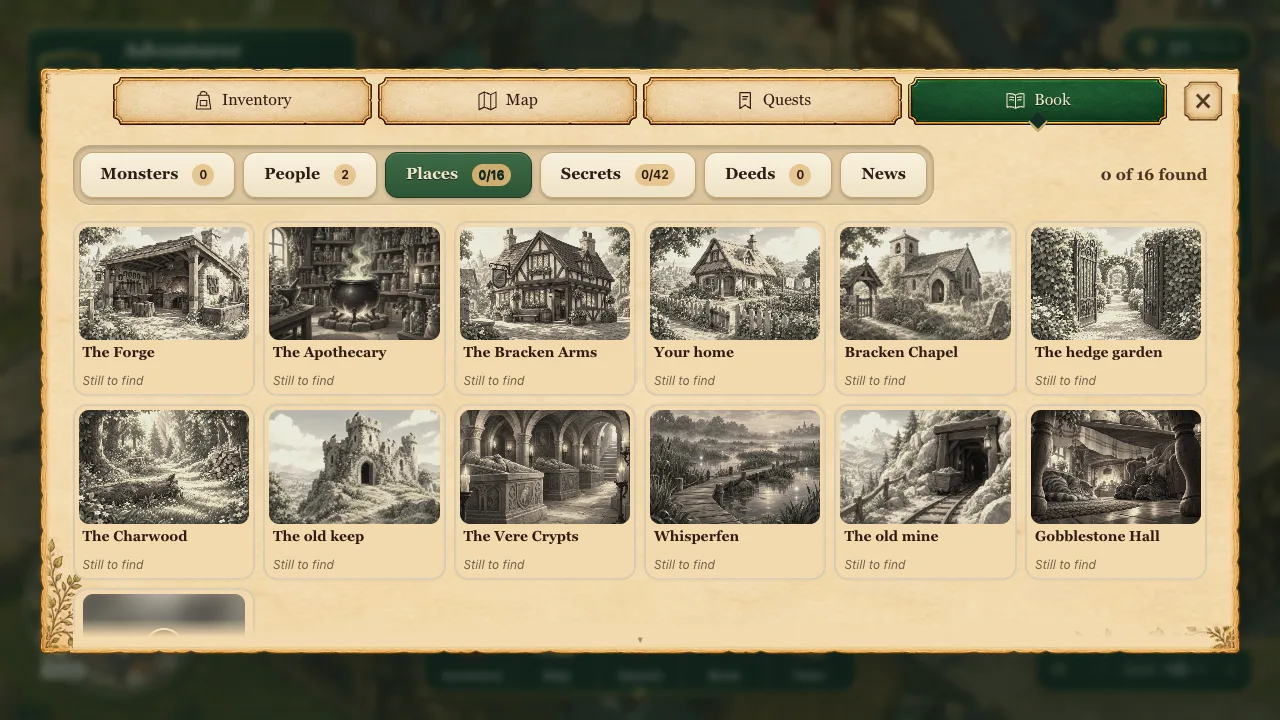 The Book's Places page on a new game: every place drawn, and still to find. Each one is ticked off once you have been there.
On a tablet
The touchscreen post moved the game onto an iPad. A lot of the HUD changed after that, so I asked whether the touch version had kept up. Mostly it had. Where it had not, it has now.
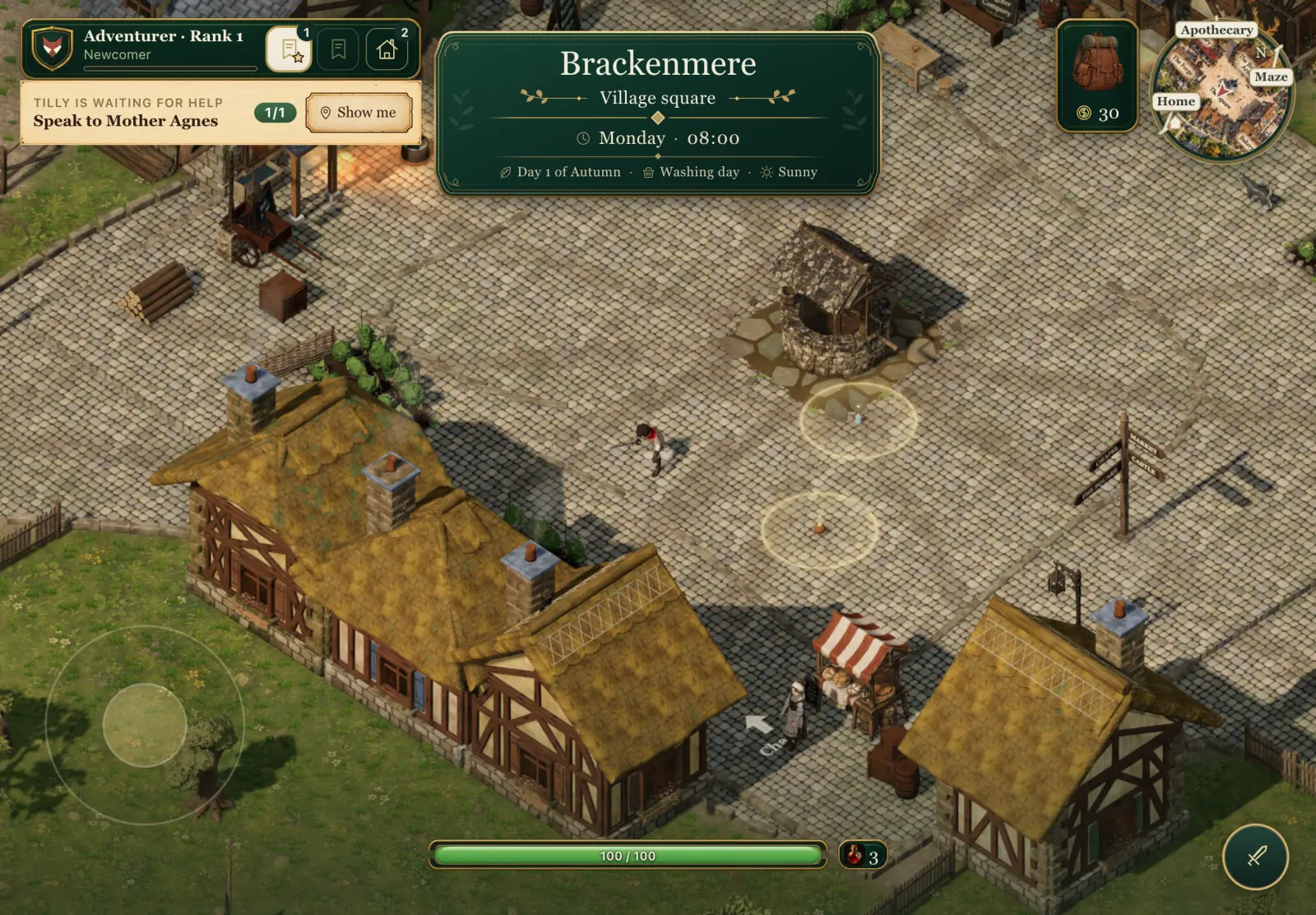
- The green band holds your gear. "I wonder if we can get attack, defence and worn pieces in the green box on an iPad. I think it's a real kind of nice little feature." The gear row and the conditions now sit in the green band under your rank, with the quest line below.
- Everything in reach gets a label. Each thing you can use, and each person you can talk to, has a lit label stacked above the health strip, in the order you came near them. Tap the one you want.
- Conversations fill the screen. On a tall screen the parchment sits in the middle and grows before it scrolls.
- The Quests panel lists the quests on offer, the same ones the card shows.
- Phones held sideways keep the place name clear of the quest tabs.
- No guest save notice. Starting a new game already says the adventure stays on this device.
Performance
The graphics settings post has the full story. Since then:
- The townsfolk are much cheaper on Low. Each remade villager has a lighter Low body that keeps the face and hands. On my iPad, the people went from a noticeable share of each frame to too small to measure.
- Changing graphics mid-run keeps the run. "If I'm in a quest or in a world and I'm halfway through a quest and I want to change my graphics settings, the warning about how I would lose my gold comes up," I said. "Surely I'm just changing my graphics settings and that shouldn't show." Now the game reloads with your run as it was, and does not ask.
- Smoother loading as you walk between parts of the village.
The Low bodies arrived in a hurry. On the afternoon of 6 November a friend told me their computer had crashed. "I think it's because of all the really high res models we pushed yesterday, and I forgot to create low res ones," I said. The Low bodies were already being built that day, and they went into the game the same afternoon.
Under the hood Each Low villager is about six and a half thousand triangles. On the iPad, the cost of drawing the town's people on Low went from roughly 3 to 12 milliseconds a frame to nothing we could measure. The 33 remade bodies were rebuilt six at a time, and each had to pass a check for dark patches in the face before it was allowed in.
Still open
Thirteen voices could not be recorded this month, so Crispin and a few others speak in text until next month's recording. The new bodies are mine to judge as I play. And on a tablet, the browser's own toolbar still takes a slice off the top of the screen. That one is next.