By the evening of 15 October Brackenmere was the busiest it had ever been. The immersion rounds had made the world answer the hero's touch, and that morning I had asked for "a slightly more engaging busy Brackenmere", which became twenty-two new villagers with homes, trades and their own weeks.
That afternoon I set up a build for the kids: "I want to load up a frozen branch for my kids to play on for feedback." Then, that evening, I asked a bigger question than any of the rounds so far.
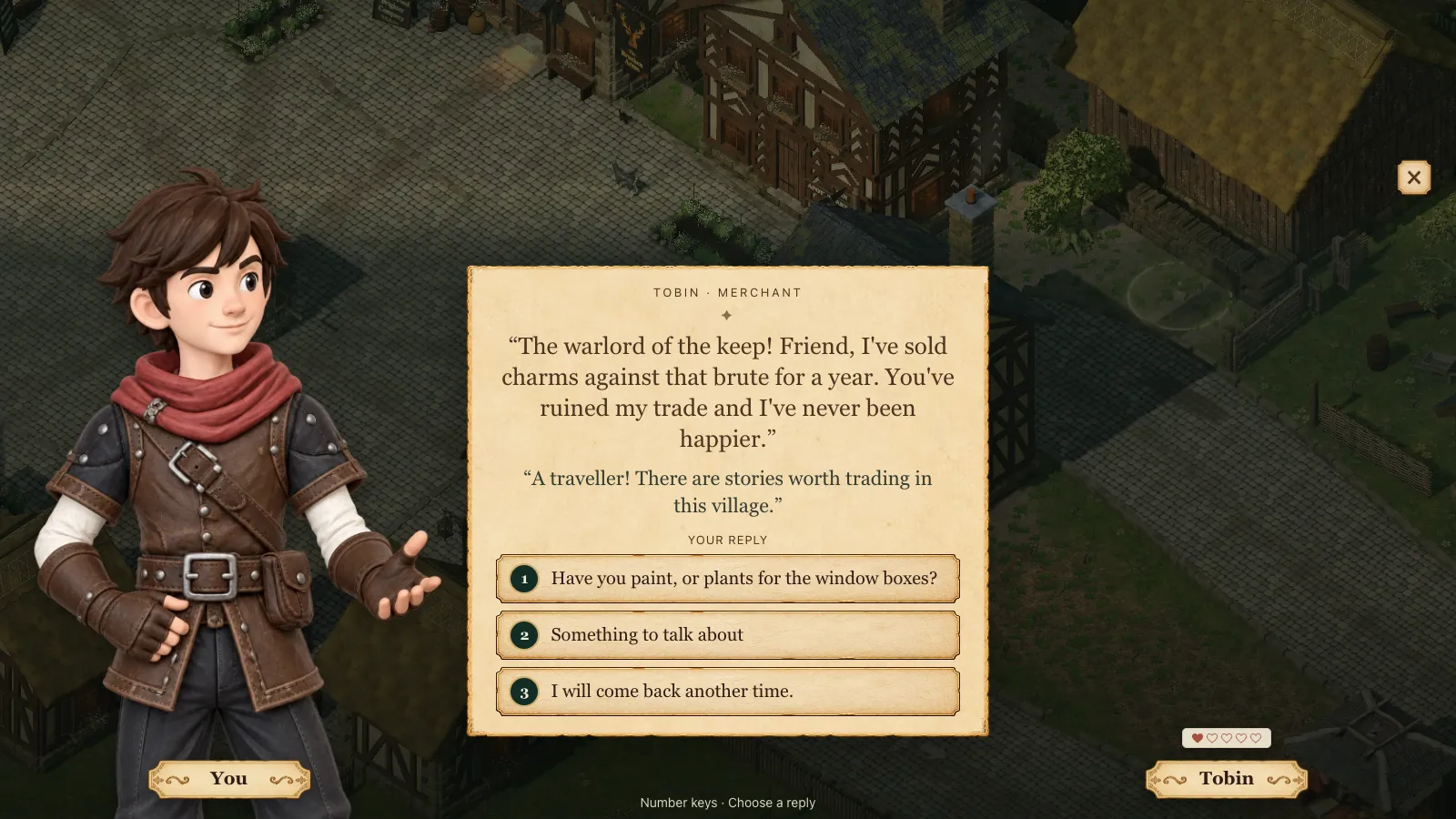 Tobin hears that the hero beat the goblin warlord.
The question
It was the second of three overnight jobs. I dictated it in one breath:
"Look at the game holistically and how it values and measures up against an enjoyable experience for 8-18 year olds to play, interact with, learn, feel like it's their own, want to share, feel invested in the world."
Then the real question: "Have we created a fairly stale world without feeling, and if so let's change that." I wanted "a breakout talked about game", something kids would "want to play and level up, improve, have some level of success and measurability (character levels?)".
I gave it "$20 on OpenAI credit, 800 meshy credits, as many ElevenLabs as needed", and the order: "three jobs, but in that order." Agent speed first, then this, then performance. "Let's go!"
Within a few minutes the orchestrating agent had cut three build areas straight from my list. I stopped it: "job B's jobs read exactly like I said, but they were suggestions. DO research and figure out what is the right thing to do, don't just take my thoughts, they are limited."
So the job began with a research round, B0, that would treat my list as hypotheses to test, reject or go beyond.
What the research found
The B0 lead played a fresh hero, read my kids' playtest notes, the design pages and the code, and sent three research agents out on motivation, the games kids and teens love, and safe social play.
Some findings were familiar. Success has to be visible and countable. Growth should be felt, not just numbered. People who remember you make deeds matter. One is easy to miss: under PEGI 2026, punishing a missed day pushes a game's rating from 7 to 12, so no streaks and no loss for being away.
Under the hood About 120 web sources, from self-determination theory to Hades, Stardew and the UK Children's Code. The scorecard rated fourteen areas out of 5: the world and atmosphere scored 4.5, progression 1.5 and social play 1.
Then came the verdict, in bold. These are the research lead's words, not mine, and the title of this post:
"Brackenmere is not stale in its world. It is stale in what the player gets back."
The village was rich. The problem was the loop: "The hero does things and too little answers back." Nothing measured the hero. Beating the Silkmother or dying in the castle never reached the town. The sim kept every villager's feelings for the hero, and nothing showed them: "Stardew's hearts are this game's biggest missed trick."
It even graded my hunch: "Nick's instinct about levels is right, with the research's caveat: the levels must unlock things you feel."
It kept my rulings too. Earlier that evening I had parked the repeating dungeons: "The hedge maze / castle and Whisperfen layout we'll tackle later." That went on its later list rather than into the night.
It proposed three areas that shared no system, so they could run side by side, which was what I had asked for: "All three can run simultaneously, as long as you are orchestrating them etc and sorting out the merge and conflicts and ensuring not two are working on the same thing." Combat, the hero's Renown and record, and a town that notices you. Renown would grow the backpack, which changed one of my standing rules. The orchestrator flagged it and I replied: "agree".
A town that notices you
The town round landed first, the same night. It measured before writing a line.
Under the hood Of 1,916 lines in the town's dialogue, none reacted to anything the hero did outside the village. The only things that moved a person's feelings were a daily chat and one story quest; a finished side quest changed nothing.
Four kinds of news now reach the town: a boss beaten, a run finished, a defeat out there, a first visit somewhere. The main cast each have a few reactions in their own voice, said once, ahead of ordinary greetings but behind quest lines, so the first people you meet after a fight mention it.
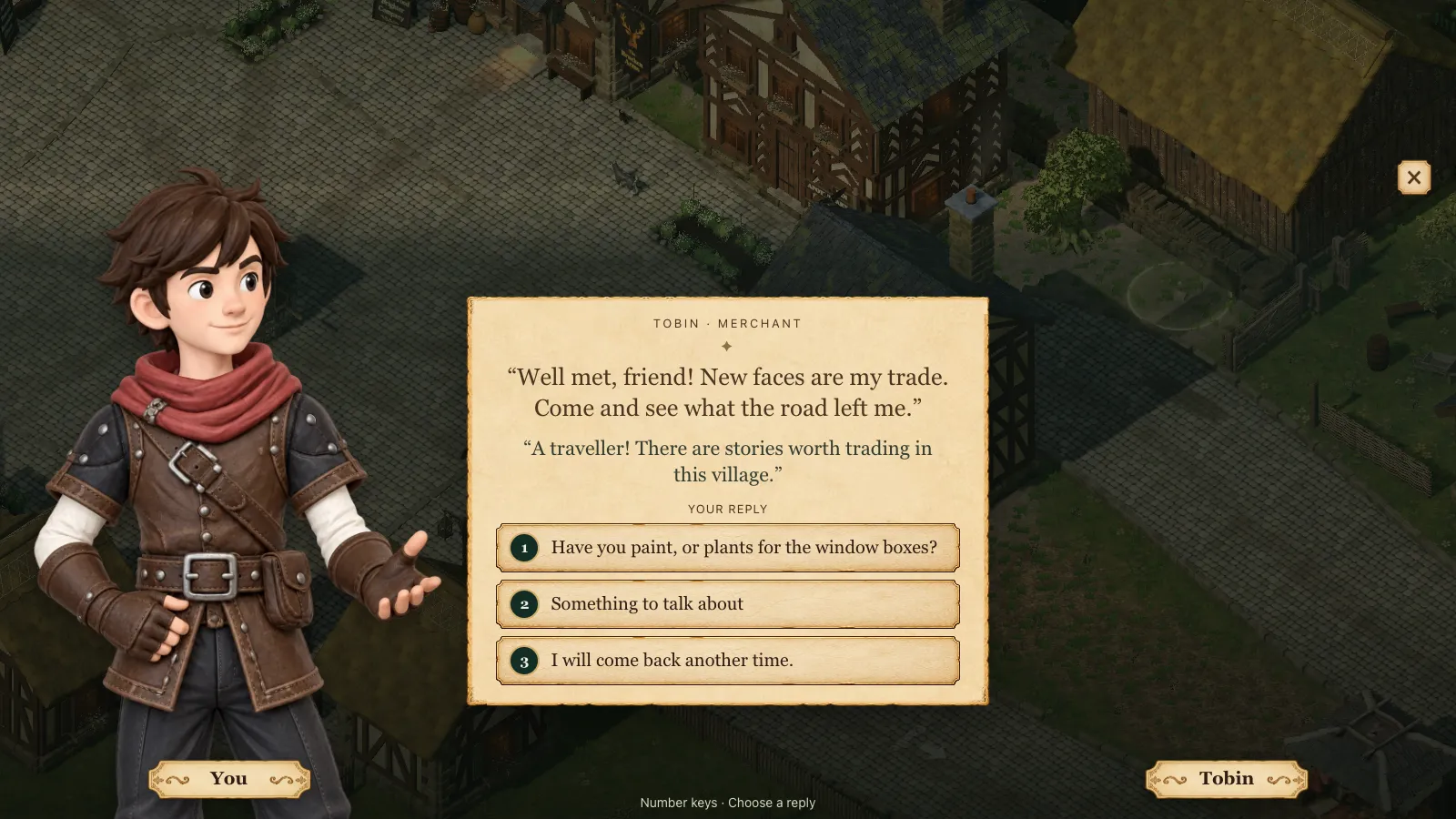 Before: the same walk up to Tobin gets a stock greeting.
The Silkmother lines say she gave way, not that she died, because in the story she yields and her spiders are wardens.
Deeds also become rumours, and rumours drift. The keep's warlord, in Hollis's telling, had his "horns clean off". By another route, the hero "tied the Silkmother's legs in a bow, and now she does as she is told". The journal shows who said it and never whether it is true.
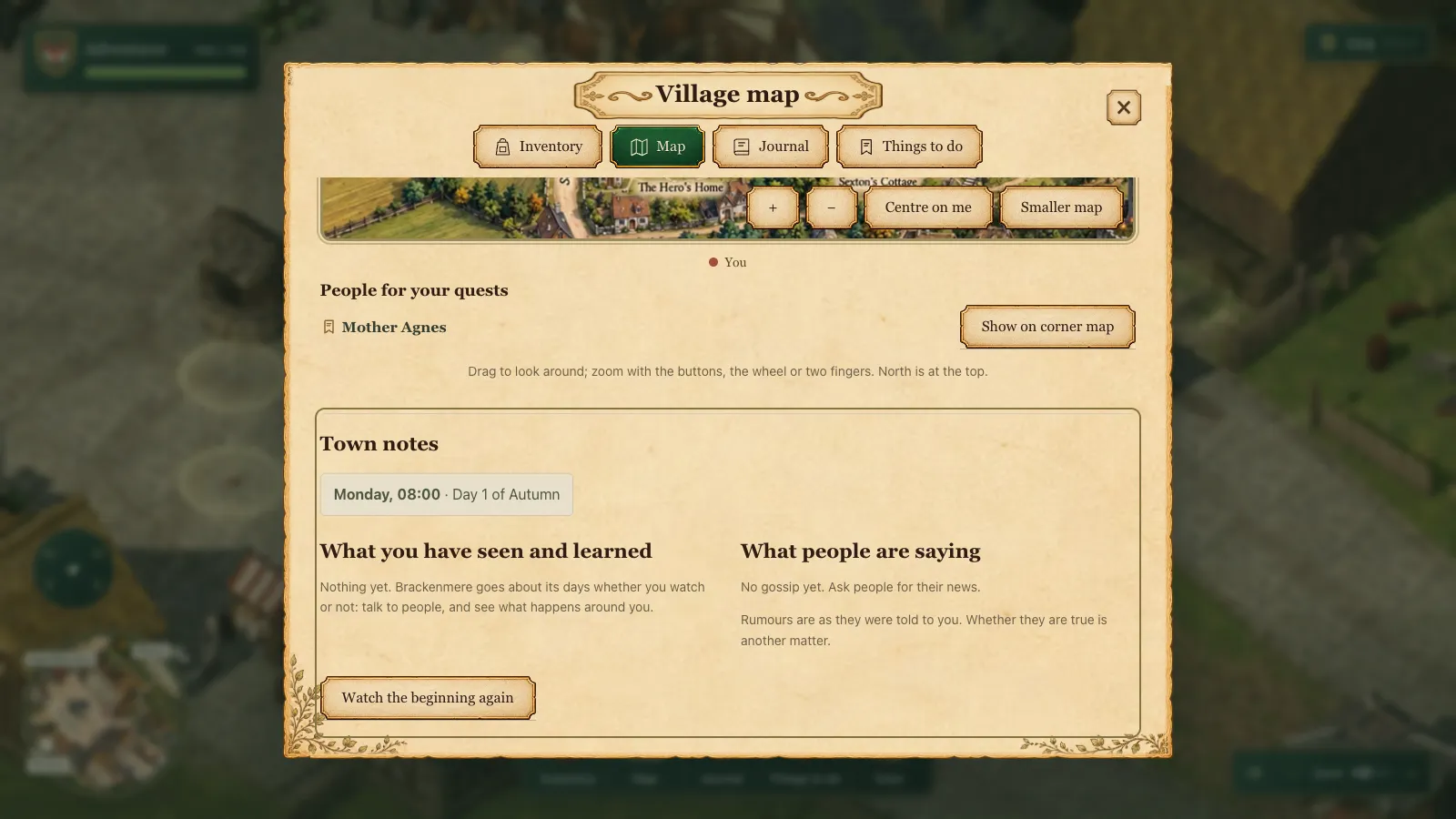 Before: the town notes under the map.
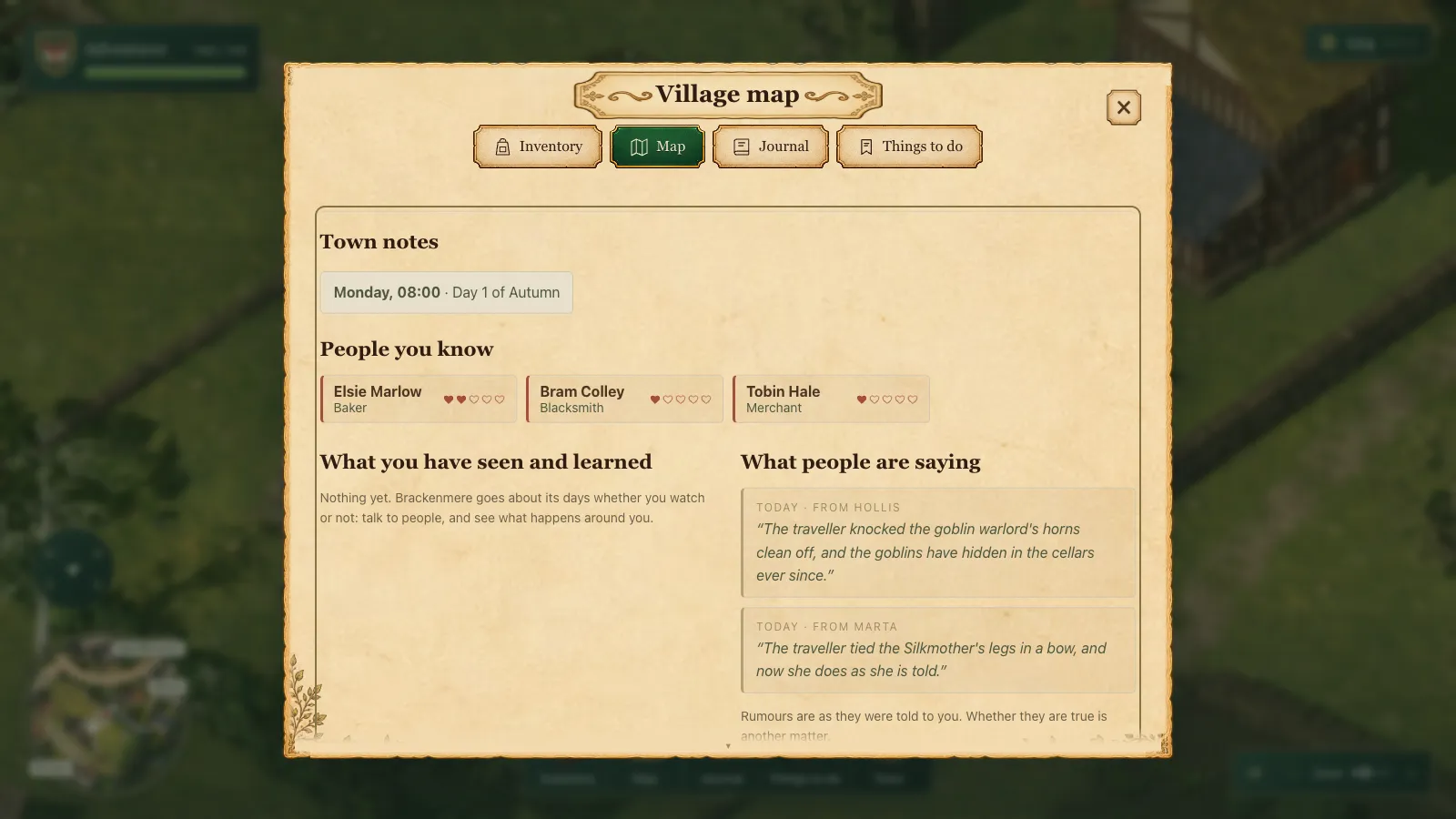 After: People you know with their hearts, and what people are saying about you.
Hearts
The hearts cost almost nothing to compute, because the numbers were already there. Five hearts sit on every conversation and in a new People you know list. Every finished quest now warms the person who gave it, and at two and four hearts the main six each say something once and hand over a small gift through the ledger.
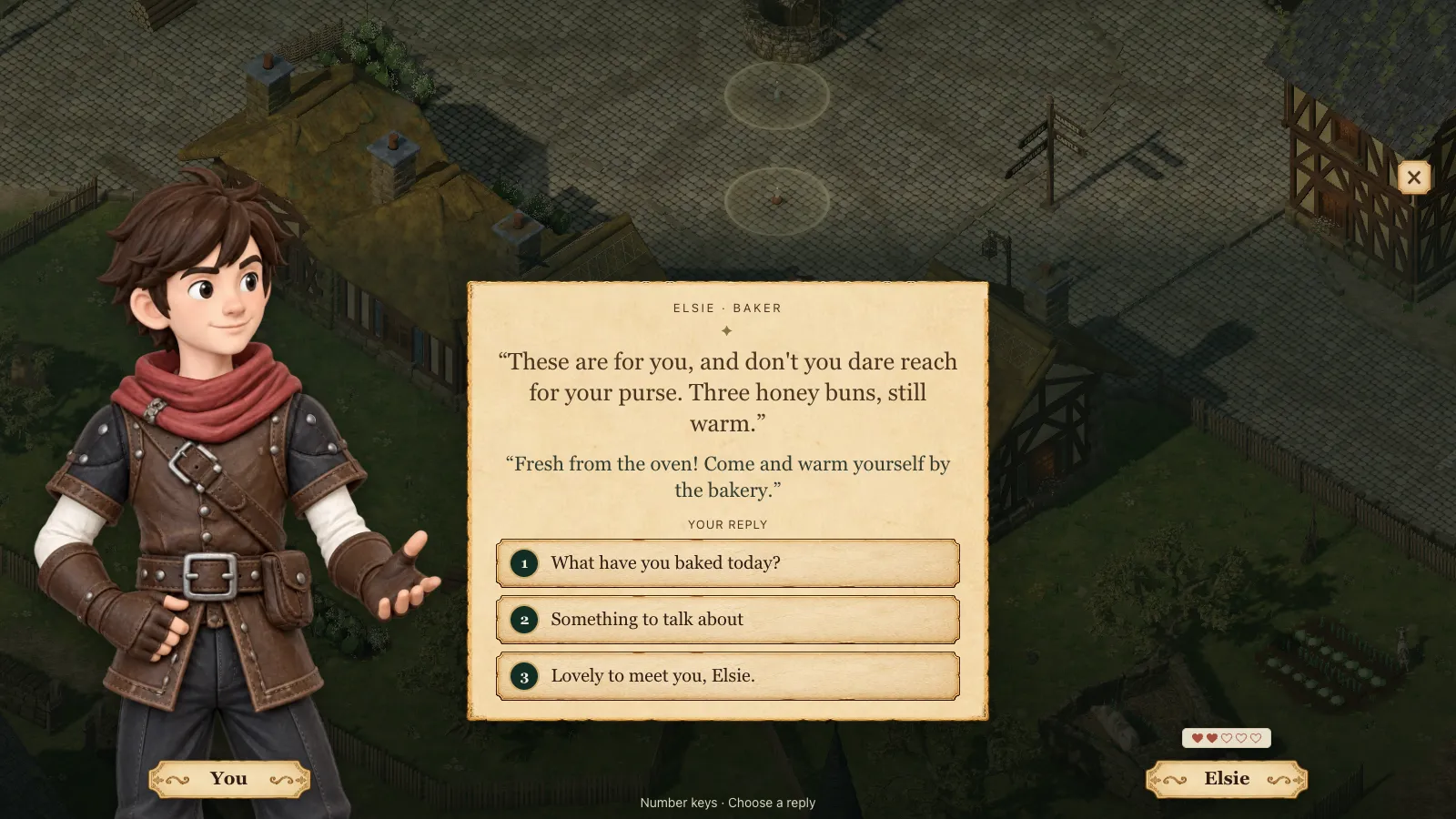 Elsie at two hearts: "don't you dare reach for your purse."
Under the hood Hearts are affinity plus half of familiarity, stepping at 15, 30, 50, 70 and 90. With a quest's thanks at 10, the verifier found Elsie at 29.5 after her quest and a chat, just under the second heart, so the thanks became 15.
Two Codex reviews caught real holes: deeds counting from preview runs, a mine with no run timer, generated adventures that never told the town where they were. The lead then walked it in the running game and recorded six passes.
It spent nothing. The reaction lines went in as text; voicing them reached outside the round, so it became its own piece.
What I took from it
My list was a list of hunches. The best finding was not on it: the town already knew how the hero stood with everyone. It had never said so.